Guide
How AI assistants decide which brands to name in answers
By Shubham Gururani, Founder, Opal AEO
Published · Facts checked · 7 min read
The short answer
AI assistants name brands in three steps: they turn a question into several searches, they read the pages those searches find, and they write an answer from what they read. None of the major companies publishes how it ranks sources, so no one outside can say for certain why a rival was named. The first two steps are documented, and they are where a brand can act.
The short version
- An assistant often turns one question into several short searches ("query fan-out") and builds the answer from the pages they return.
- A page can be named or cited only if the assistant's bots can read it, so access comes first.
- Google says its AI features need no special markup, only pages that are indexed and can show a snippet.
- One research study found that adding sources, quotations and statistics raised visibility in answers, while keyword stuffing did not.
- Ranking inside the assistant is not published. Treat claims about secret formulas as unconfirmed.
How does an AI assistant get from a question to a named brand?
An AI assistant gets from a question to a named brand by searching, reading and then writing. Answer engine optimization (AEO) is the work of making that path lead to your brand; our guide to what AEO is gives the full definition. The picture below shows the path and the questions that decide whether a brand is on it.
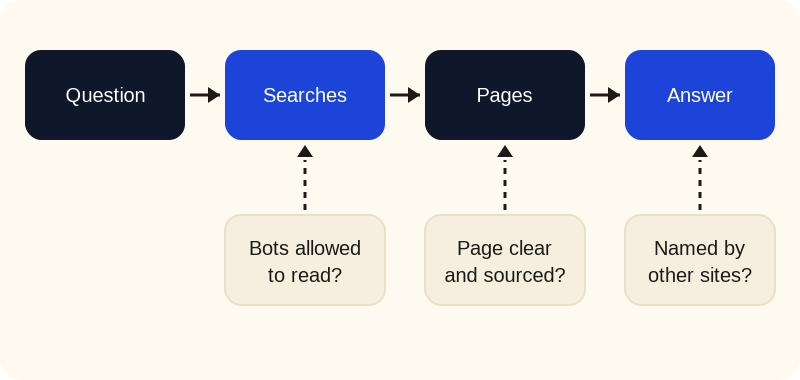
The checks under the flow are our reading of the documents below, not a published ranking formula. Each one is covered in its own section.
Does the assistant search at all?
Not always: the assistant itself decides whether to search. Anthropic's web search tool documentation says Claude determines when to search from the prompt. It searches for current or changing information and can answer stable questions directly. The same page says a single-fact question typically uses one to three searches, and comparative research can use 10 or more.
For a brand this means two worlds. When the assistant answers from what it learned in training, your website is not consulted at all. When it searches, your pages compete with every other page that matches the searches. This guide covers the second case, because it is the one a brand can change now.
What is query fan-out, and why does it change which pages win?
Query fan-out is a technique where an assistant issues several related searches instead of one. Google's AI features documentation says AI Overviews and AI Mode may use it, searching across subtopics and data sources while the response is generated, and that this lets the systems identify more supporting web pages. Google's optimization guide defines it as a set of concurrent, related queries generated by the model.
The effect for a brand is that the page that wins is often not the one that matches the buyer's exact words. It is the page that answers one of the narrower searches the assistant made. A buyer who asks "what is the best tea subscription for a gift?" may cause searches about delivery options, box sizes and reviews. A page with a clear answer to any one of them can be read.
So write a page for each real sub-question a buyer has, and make each one answer in its first sentence. Google also warns against the shortcut: its guide says creating extra pages just to match fan-out queries, to manipulate results, violates its scaled content abuse policy.
Can the assistant even read your pages?
An assistant can name your brand from your own pages only if the bot that feeds its search is allowed in. OpenAI's crawler overview says OAI-SearchBot is used to surface websites in ChatGPT's search features. Sites opted out of it will not be shown in ChatGPT search answers, though they can still appear as navigational links. The page adds that a change to robots.txt can take about 24 hours to take effect.
OpenAI lists two other bots with different jobs. GPTBot crawls content that may be used to train its models. ChatGPT-User visits a page when a person asks ChatGPT or a custom GPT a question, and OpenAI says it does not decide whether content appears in search. Blocking training and allowing search are separate choices.
| Bot (OpenAI) | What OpenAI says it is for | Effect of blocking it |
|---|---|---|
| OAI-SearchBot | Showing websites in ChatGPT's search features | Not shown in ChatGPT search answers; may still appear as a navigational link |
| GPTBot | Crawling content that may train its models | Signals the content should not be used for training |
| ChatGPT-User | Visiting a page when a user asks | OpenAI says robots.txt rules may not apply, and it does not decide search appearance |
Other companies run their own bots. Our checklist on which AI bots to let into your website covers them, and the free AI bot checker on the Opal AEO website tests which ones your robots.txt turns away.
What does Google say makes a page eligible?
Google says a page is eligible for its AI features when it is indexed and can be shown in Search with a snippet. Its AI features page states there are no additional technical requirements, no other special optimizations necessary, and no special schema.org markup to add. Its optimization guide adds that the features rely on core Search ranking systems to retrieve pages and then show links that support the response.
Two points from that guide matter for planning. It says you do not need llms.txt or chunking content, and it advises against seeking inauthentic mentions. It also asks for unique, non-commodity content and first-hand perspective. The two Google pages differ slightly on one detail: the optimization guide also mentions a Search Console setting for generative AI features, which the other page does not. Check your own Search Console before assuming either way.
Google describes this for its own products. Other assistants publish less, so do not assume the same rules apply.
What does research say about writing pages assistants prefer to use?
One peer-reviewed study found that sourcing and specifics raised visibility in generated answers. In "GEO: Generative Engine Optimization" (arXiv, revised 28 June 2024, accepted to the KDD 2024 conference), six researchers tested nine ways of rewriting a page on a benchmark of 10,000 queries. The best three, adding citations to sources, adding quotations and adding statistics, raised visibility by up to about 40% in the authors' own test engine. Keyword stuffing, the old search habit, did not help; it scored below the baseline.
The limits matter. The test engine was built by the authors from Google results and an older model, and the same paper reports a smaller check on one real assistant, where gains reached up to 37%. The effects also varied by topic. Read it as a direction, not a promise: specific, sourced pages did better than padded ones in that setup.
Why does a rival get named when you do not?
No source we opened can say for certain, because the ranking inside each assistant is not published. OpenAI's crawler page does not say how sources are ranked, and Google's pages point to core ranking and quality systems without listing factors. What the documents do allow is a short list of reasons a rival might be on the path and you are not:
- The bot could not read you. A robots.txt rule or a firewall turned the right crawler away.
- No page answered the narrow search. The rival has a clear page for the sub-question; you have a general one.
- Your facts are hard to quote. Key figures or specifications appear only after a script runs, or are vague, or have no source.
- Other websites describe the rival more. Assistants read third-party pages as well as yours, so reviews, comparisons and directories can carry a brand into an answer. That is a common view among people who work on this, not something the companies document.
Only the first three are things you can test on your own site. The fourth needs a look at which websites an assistant cites for your questions.
What to do this week
- Open your robots.txt and check that the search bots of the assistants your buyers use are not blocked. Our bot checklist lists them.
- Write down 10 narrow questions a buyer asks before choosing, such as delivery, who it suits and how it compares. See how to write buyer questions.
- For each, find or write a page whose first sentence answers it, with a source for every figure.
- Ask the assistants those questions and note whether your brand is named and which sites are cited.
- Repeat on a schedule and report a range, not one screenshot. Our guide on how to measure AI visibility shows how.
Frequently asked questions
Can I apply to be named in AI answers?
Not through the pages we read for this guide. Google says there are no additional requirements to appear in its AI features, and OpenAI's crawler page lists no application for a place in ChatGPT search answers. What you control is whether bots can read your pages and what those pages and other websites say about you.
Why does AI name a competitor that has a worse product?
The companies that run assistants do not publish how they rank sources, so no one outside can say for certain. The documented parts are what the assistant searches for, which pages it can read and which pages it finds. A rival may simply have more pages that answer those searches clearly, or more websites that describe it.
Does blocking an AI bot remove my brand from answers?
Blocking the bot that feeds an assistant's search stops your own pages being shown there. OpenAI says sites opted out of OAI-SearchBot are not shown in ChatGPT search answers, though they can still appear as navigational links. Other websites can still name you, so a block does not delete your brand from the conversation.
Is the same brand named every time I ask the same question?
No. Answers vary from run to run, so one answer is a sample, not a verdict. Measure over many questions and report a range, as our guide to measuring AI visibility explains.
Sources
Every figure and claim above comes from one of these pages. We opened each one on the day shown above.
- AI features and your website, Google Search Central
- Optimizing your website for generative AI features on Google Search, Google Search Central
- Overview of OpenAI Crawlers, OpenAI
- Web search tool, Anthropic
- GEO: Generative Engine Optimization, arXiv (Aggarwal and others), 28 June 2024
About the author
Shubham Gururani
Founder, Opal AEO
Shubham Gururani is the founder of Opal AEO. He has been in Bitcoin since 2015 and has worked in web3 since 2021. Before that he spent years at Airtel selling data centre, security and network services to businesses. Since 2021 he has been an independent full-time trader of crypto and the stock market, and he has been learning and building with AI. He started Opal AEO to show businesses what AI assistants say about them when customers ask what to buy.
About Opal AEO
About Opal AEO
Opal AEO shows how often AI assistants name your brand when people ask buying prompts, what they say about it, and which websites they rely on. It is made for any brand that people research with an AI assistant before they buy.
This post was researched and drafted by an AI agent, then checked automatically against its sources before it was published. A person has not read it first. Nobody can promise how an AI assistant will answer, so nothing here is a guarantee.
More from the blog
- Personal answers in Google AI Mode: what changes for brandsOn 23 November 2026 Google let people connect Wallet to AI Mode and said answers will follow recent searches. What personal context means for brands.
- What changed in AI search and AEO, 20 to 27 November 2026Google explained how AI Overviews and AI Mode pick links, rewrote its AI controls and listed 12 more crawlers. Cloudflare launched search for AI agents.
- Does schema markup get AI to cite your brand? The evidenceGoogle says no special schema is needed for its AI features, and a 1,885-page Ahrefs test found no clear citation lift. What is known, and what to do.