Guide
How to measure AI visibility, and why one screenshot lies
By Shubham Gururani, Founder, Opal AEO
Published · Facts checked · 10 min read
The short answer
To measure AI visibility, write a fixed set of buyer questions that do not name your brand, ask each one on the AI assistants your buyers use, and count the share of answers that name you. Repeat the same check on a schedule and report every score with its range. One screenshot is one answer, which tells you almost nothing.
The short version
- AI visibility is the share of answers to buyer questions that name your brand.
- Fix the questions, the assistants and the settings first, then keep them the same from check to check.
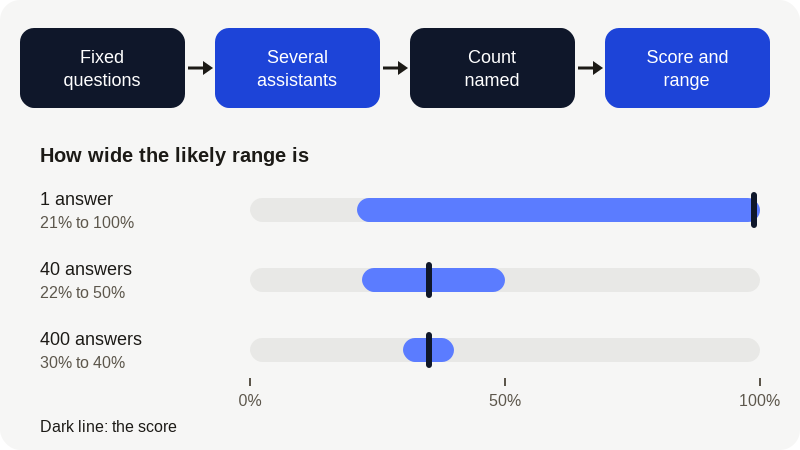
- One answer is a sample of one: if it names you, the likely true score runs from 21% to 100% (Wilson method).
- Put a range on every score: at 35%, even 40 answers leave a range of about 22% to 50%.
- Call a move a change only when the two ranges do not overlap at all.
What is AI visibility, as a number?
AI visibility is the share of answers to buyer questions that name your brand. If AI assistants answer 40 buyer questions and name your brand in 14 of the answers, your visibility is 35%. It is the first number in answer engine optimization (AEO), the work of getting AI assistants to name and describe a brand correctly; our guide to what AEO is covers the rest.
Count one thing per answer: named or not named. The order of brands in a list changes too often to track. A study by SparkToro, a market research firm, and Gumshoe.ai, a startup that sells AI tracking, was reported by Communicate Online on 25 February 2026. Its authors said the share of answers that name a brand may be more reliable than its ranking position.
Two other numbers sit next to visibility, and each answers a different question.
| Measure | What it tells you | Where it comes from |
|---|---|---|
| Visibility (mention rate) | How often AI names your brand for buyer questions | Your own question set, asked on each assistant |
| Citation share | How often your pages are among the sources an answer links | The links in those same answers; Bing's AI Performance report for Microsoft's surfaces |
| Clicks and impressions | Visits from search results, AI features included | Google Search Console, Web search type |
Citation share counts the sources an answer links, so it shows which websites AI relies on, yours or not. AI citation tracking lists the websites cited in the answers to your questions, so you can see where your brand is missing.
Why does one screenshot lie?
One screenshot is a single answer, and a single answer cannot tell you how often an assistant names you. Answers change from one run to the next. In the SparkToro and Gumshoe.ai study, 600 volunteers asked a dozen questions on ChatGPT, Claude and Google's AI search tools, giving 2,961 responses, according to Communicate Online. The authors found less than a one-in-100 chance that ChatGPT or Google's AI systems gave the same brand list twice. The report adds that the study was not peer reviewed.
The arithmetic makes the same point. Statisticians put a range around a share so you can see how sure it is. With the Wilson method, which the NIST statistics handbook describes as recommended for virtually all sample sizes and shares, one answer that names you fits any true score from 21% to 100%. One answer that leaves you out fits anything from 0% to 79%.
So a screenshot a colleague shares, good or bad, fits almost any real score. It shows one wording, on one assistant, at one moment.
Step 1: How do you declare your question set?
Declare your question set by writing every question down, with an ID, before the first check, and keeping the list the same from then on. A fixed, written list stops anyone picking the questions after seeing the answers. It also lets you match each question across checks.
Write the questions from the buyer's side, in their words, with no company, product or plan name in them. Our guide on how to write buyer questions that measure AI visibility fairly walks through it step by step.
Keep any question that names your brand on a separate list, and leave it out of the headline score. In one Opal AEO audit of a stock broker on 16 October 2026, 20 buyer questions were each asked three times on Perplexity with web search on. Counting all 20 questions, the broker was named in 47% of answers; counting only the 17 that did not name it, in 37%. That is one firm, one assistant and 20 questions, but the direction is clear: branded questions flatter the score. The buyer questions guide explains why.
Step 2: Which assistants do you ask, and how?
Ask on the AI assistants your buyers use, and ask the same way every time. Before the first check, write down for each assistant:
- The assistant and, if it shows one, the model or product name.
- Whether web search was on (keep it on where the assistant offers it, and the same at every check).
- The location setting, if the assistant has one.
- The date of the check.
Report each assistant on its own line, because results differ between them. In the SparkToro study, the three most-named brands appeared on average in 64% of ChatGPT answers, 73% for Claude and 68% for Google AI, according to Communicate Online. One combined number can hide a weak spot on one assistant. If you also want one number, combine them with weights you write down, such as equal weights, and use the same weights next time.
Step 3: Should you ask more questions or repeat the same ones?
Ask more different questions rather than repeating the same ones, because a repeat often adds little. In the same stock broker audit, all three runs of a question gave the same result, named or not named, for 95% of the 20 questions on Perplexity.
That finding has limits. It comes from one firm, one assistant and one day, and the SparkToro study found much more change between answers on ChatGPT and Google's AI, though it measured whole brand lists rather than named or not named. If you do repeat questions, count the answers to one question together rather than as new questions. For the same effort, 40 different questions tell you more than 10 questions asked four times.
Step 4: How do you put a range on the score?
Put a range on the score by counting your answers and your mentions, then working out the likely range with the Wilson method, which a statistics calculator or spreadsheet can do. The NIST handbook gives the formula. The table below shows how the range narrows as the number of answers grows, for a brand named in 35% of them.
Example, worked out for illustration with the Wilson method at a 95% level:
| Answers counted | Named in | Score | Likely range |
|---|---|---|---|
| 1 (one screenshot) | 1 | 100% | 21% to 100% |
| 20 | 7 | 35% | 18% to 57% |
| 40 | 14 | 35% | 22% to 50% |
| 100 | 35 | 35% | 26% to 45% |
| 200 | 70 | 35% | 29% to 42% |
| 400 | 140 | 35% | 30% to 40% |
As a rough guide at this level, 40 answers leave about 15 points either side, 100 answers about 10 and 400 answers about 5. The method counts every answer as separate. Answers to the same question often agree, so treat the table's range as the narrowest the real one could be.
Report the score in one line anyone can check: the share of answers that named you, its likely range, the number of answers, assistants and questions, and the date. For the table's middle row that reads: named in 35% of answers, likely 22% to 50%, from 40 answers.
Step 5: How do you know if visibility really changed?
Compare two checks only on the questions and assistants both of them asked, then use a cautious rule: call a move a change only when the two ranges do not overlap at all. If they overlap, the honest reading is "can't tell yet". A new or dropped question, or a different assistant, changes what the score is made of.
Why not "the new score falls outside the old range"? That rule treats the new score as exact, but it has a range of its own, so it calls changes that are only noise more often than it looks. Two ranges that do not touch is stricter. It can miss a small real change, which more questions will settle.
Count each question once. If you ask a question several times, the answers to it tend to agree, so they are not separate evidence. When you judge a change, the number that matters is the number of different questions, not the number of answers you collected. The table's ranges count every answer as separate, so they are the narrowest the real ones could be, which is one more reason to stay cautious.
Example, written for illustration: Brightwell Tea, a made-up brand, asks the same 20 questions on the same two assistants four weeks apart.
- First check: named in 14 of 40 answers, 35% (likely 22% to 50%).
- Second check: named in 18 of 40 answers, 45% (likely 31% to 60%).
The two ranges overlap, so the honest reading is "can't tell yet", not "up 10 points". Had the second check named Brightwell Tea in 28 of 40 answers, 70% (likely 55% to 82%), the two ranges would not touch, and a real rise would be much more likely. This is a rule of thumb, not a full statistical test. A stronger way is to compare question by question: count the questions that went from not named to named, and the ones that went the other way. A real rise shows up as many more moving up than down. Opal AEO shows every visibility score with its range for this reason, as the AI Visibility page explains.
What do Search Console and Bing show, and what do they miss?
Search Console and Bing Webmaster Tools show traffic and citations of your own pages, not how often an AI answer names your brand. Use them next to your question set, not instead of it.
Google Search Central says sites shown in AI features such as AI Overviews and AI Mode are counted in the overall search traffic in Search Console, in the Performance report under the Web search type. That shows clicks and impressions of your pages, mixed in with ordinary results. An answer that names your brand without linking your site is not your page appearing, so it is not what this report counts.
Bing's AI Performance report, introduced as a public preview in a Microsoft Bing Blog post of 10 February 2026, shows how often your content is cited in answers across Microsoft Copilot, AI summaries in Bing and some partner services. It lists the cited pages and a sample of the search phrases the AI used. On 16 June 2026, Bing added Citation Share, your share of citations for a search phrase, and says it does not expose competitor domains.
What to do this week
- Write 20 buyer questions with no brand name in them, give each an ID, and freeze the list (use the buyer questions guide).
- Ask each question once on two assistants your buyers use, with web search on, and record named or not named for each answer, with the date and the settings.
- Work out the score and its Wilson range, and write it down as "35% (likely 22% to 50%), 40 answers, date".
- Book the same check for four weeks from now, with the same questions and assistants, and call a move a change only if the two ranges do not overlap at all.
- Open Search Console's Performance report, and Bing's AI Performance report if you use Bing Webmaster Tools, to see clicks and citations next to your score; check too that AI bots can read your site.
Frequently asked questions
How many buyer questions do I need to measure AI visibility?
No source we found gives one number that is enough. More answers narrow the range: at a score of 35%, 40 answers give a likely range of about 22% to 50%, and 400 answers about 30% to 40%. Start with 20 to 50 questions that name no brand, and add more if the range is too wide for the decision you need to make.
Should I combine several AI assistants into one score?
Report each assistant on its own line first, because they can give very different results. If you also want one number, combine them with weights you write down, such as equal weights, so the next check uses the same ones.
Why count whether my brand is named instead of its position in the answer?
Lists and their order change from one answer to the next. In the study reported by Communicate Online on 25 February 2026, the authors said the share of answers that name a brand may be a more reliable measure than its ranking position.
Does Google Search Console show my AI visibility?
Only in part. Google says pages shown in AI Overviews and AI Mode are counted in the Performance report under the Web search type, together with ordinary results. That shows clicks and impressions of your pages, not how often an AI answer names your brand in its text.
Sources
Every figure and claim above comes from one of these pages. We opened each one on the day shown above.
- AI brand recommendations vary, marketers warned on tracking tools, Communicate Online, 25 February 2026
- 7.2.4.1. Confidence intervals (NIST/SEMATECH e-Handbook of Statistical Methods), NIST
- AI features and your website, Google Search Central, 10 December 2025
- Introducing AI Performance in Bing Webmaster Tools Public Preview, Microsoft Bing Blog, 10 February 2026
- New AI Visibility Insights in Bing Webmaster Tools: Intents, Topics, Citation Share, Compare, Microsoft Bing Blog, 16 June 2026
About the author
Shubham Gururani
Founder, Opal AEO
Shubham Gururani is the founder of Opal AEO. He has been in Bitcoin since 2015 and has worked in web3 since 2021. Before that he spent years at Airtel selling data centre, security and network services to businesses. Since 2021 he has been an independent full-time trader of crypto and the stock market, and he has been learning and building with AI. He started Opal AEO to show businesses what AI assistants say about them when customers ask what to buy.
About Opal AEO
About Opal AEO
Opal AEO shows how often AI assistants name your brand when people ask buying prompts, what they say about it, and which websites they rely on. It is made for any brand that people research with an AI assistant before they buy.
This post was researched and drafted by an AI agent, then checked automatically against its sources before it was published. A person has not read it first. Nobody can promise how an AI assistant will answer, so nothing here is a guarantee.
More from the blog
- Personal answers in Google AI Mode: what changes for brandsOn 23 November 2026 Google let people connect Wallet to AI Mode and said answers will follow recent searches. What personal context means for brands.
- What changed in AI search and AEO, 20 to 27 November 2026Google explained how AI Overviews and AI Mode pick links, rewrote its AI controls and listed 12 more crawlers. Cloudflare launched search for AI agents.
- Does schema markup get AI to cite your brand? The evidenceGoogle says no special schema is needed for its AI features, and a 1,885-page Ahrefs test found no clear citation lift. What is known, and what to do.