How to
How to write buyer questions that measure AI visibility fairly
By Shubham Gururani, Founder, Opal AEO
Published · Facts checked · 7 min read
The short answer
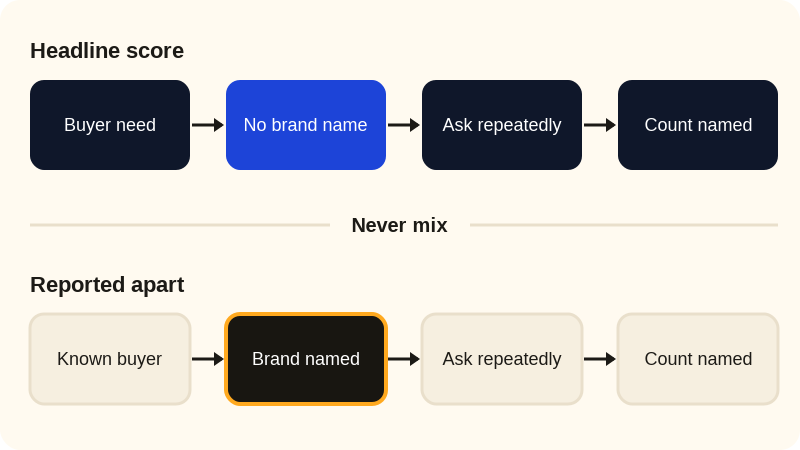
A buyer-side question is one a person would type before they know your brand exists: it describes a need and names no company, product or plan. To measure AI visibility fairly, write your questions that way, keep any question that names your brand on a separate list, and ask each question more than once. In one Opal AEO audit, mixing the two kinds raised a score by 10 points.
The short version
- Start from what a buyer wants before they know your brand, not from what you sell.
- Keep brand, product and plan names out of the questions that make the headline score.
- Put every question that names your brand on a second list and report it apart.
- Write more than one wording of each need, and ask each question more than once.
- Count one thing per answer, named or not named, and report the date, the assistant and the number of questions.
What is a buyer-side question?
A buyer-side question is a question written in the words of a person who has a need and has not chosen a brand yet. "Where can I buy good loose-leaf green tea online?" is one. It describes a situation, names no company and could be typed by anyone.
The opposite is a branded question, which names the brand being measured. "Is Brightwell Tea any good?" is a branded question. (Example, written for illustration: Brightwell Tea is a made-up brand that sells loose-leaf tea.) It shows what an assistant says about a brand the buyer already knows. It cannot show whether the assistant brings the brand up on its own.
Write each question as a full sentence with the buyer's situation in it. Google says AI Overviews and AI Mode may use a technique called query fan-out, which issues several related searches across subtopics before the answer is written. Because the assistant expands the buyer's question into its own searches, the question you test should be the sentence a buyer would type, not a keyword you chose. Our post on Gemini 4 Hydrogen in Google Search covers how Google describes fan-out.
Why does a question that names your brand inflate the score?
A question that names your brand makes the brand easy to name, so it lifts the score without showing that strangers are being sent to you. Opal AEO measures how often AI assistants name a brand when people ask buying questions, so the wording of those questions decides what the number means.
The audit behind this post was of a stock broker and was run on 16 October 2026. Twenty buyer questions were each asked three times on Perplexity with web search on. Three of the 20 questions named the broker.
| Questions counted | Share of answers that named the broker |
|---|---|
| All 20 questions | 47% |
| Only the 17 that did not name the broker | 37% |
| Difference | 10 points |
The 10 points came from the three questions that named the broker. Reported on separate lines, the no-brand figure is the one that describes buyers who do not know the broker yet. The audit's conclusion is that branded and no-brand questions should be reported separately.
The limits are one firm, one assistant, 20 questions and one day. The result shows that the gap can be large. It does not show that the gap would be 10 points for another brand or assistant.
A question can name a brand without using its name. A product name, a plan name or a feature that only one company offers points to that company. The audit measured only questions that named the broker, so treat the rule about products and features as a cautious guess, not a result.
How do you write buyer-side questions, step by step?
Seven steps take you from the buyer's need to a count of answers.
- List what a buyer wants before they know you. That means a problem to solve, two options to compare, or an alternative to something they already use. Take the words from sales calls, support chats and the search queries that already bring visitors to your site.
- Write each need as one full question. Put the situation in it ("for someone new to tea"). Write it the way a person types it to an assistant.
- Remove your brand, product and plan names. The test is simple: could someone who has never heard of you have written this question? If not, move it to the branded list.
- Write two or three wordings of every important need. People word the same need in very different ways, and the next section shows how different.
- Put the questions that name your brand on a second list. Keep it short. It shows what assistants say when a buyer already knows you.
- Ask every question more than once, on each assistant separately. Turn web search on where the assistant offers it, as the audit above did.
- Write down one thing for each answer: was the brand named, yes or no. Count each list on its own.
What does a good set look like?
A good set has several no-brand wordings for each need, plus a short, separate list of questions that name the brand. The table shows one need, written both ways.
Example, written for illustration, with the made-up brand Brightwell Tea:
| Question | List | Why |
|---|---|---|
| Where can I buy good loose-leaf green tea online? | Headline | A buyer's need, with no company named. |
| Which loose-leaf teas suit someone new to tea? | Headline | The same need in a second wording. |
| What is a better alternative to tea bags? | Headline | A comparison a buyer makes before choosing a brand. |
| Is Brightwell Tea any good? | Branded | It names the brand. |
| Which shop sells the Brightwell Morning Blend? | Branded | A product name works like a brand name. |
The last row looks like a shopping question, but only a buyer who already knows the brand would write it. It belongs on the branded list.
Why write several wordings and ask each question more than once?
Write several wordings of each need and ask each question more than once, because both the wording and the answers vary. Search Engine Journal reported on 30 January 2026 on a study by SparkToro's co-founder Rand Fishkin and Patrick O'Donnell of Gumshoe.ai, which the article says sells AI tracking tools. In it, 142 participants wrote their own prompts about headphones for a traveling family member, and almost no two prompts looked alike. Four brands still appeared in 55% to 77% of the 994 responses.
The same study found that exact brand lists almost never repeated. Communicate Online, reporting on 25 February 2026, says ChatGPT and Google's AI systems had under a one-in-100 chance of giving identical brand lists on repeat queries. Both reports pass on the authors' view that the share of responses naming a brand is steadier than a brand's place in a list.
That is why step 7 counts a yes or no for each answer and not a position. In the stock broker audit, all three runs of a question gave the same result, named or not named, for 95% of the 20 questions. That was on Perplexity only, and it counts something simpler than the whole lists in the reported study, so the two results do not conflict. On that assistant, asking more different questions revealed more than repeating one question. The audit's note is that this may not hold for assistants whose answers change more, such as those in the study.
What are the limits of this method?
The method makes a score fairer, but it does not make it exact. Four limits matter.
- Your questions are a sample. They are a small part of what buyers could ask.
- One assistant is not all assistants. Report each one on its own line.
- The evidence is thin. Communicate Online notes that the study was not peer reviewed, and Search Engine Journal says its authors left open how many prompt runs reliable visibility data needs.
- The 10-point gap is one case. It comes from one firm, one assistant, 20 questions and three runs on one day.
What to do this week
- Write 10 buyer-side questions in real buyer words, with no company, product or plan name in them.
- Add a second wording for the three needs that matter most to your sales.
- Write a separate list of up to five questions that name your brand.
- Ask every question three times on each assistant your buyers use, with web search on where it is offered. Record named or not named for each answer, and write the date.
- Report the two lists on separate lines with counts, and check first that AI bots can read your site: see which AI bots to let in.
Frequently asked questions
Should I ever ask questions that name my brand?
Yes, on a separate list. They show what an assistant says once a buyer already knows your brand, for example whether the description is right. Keep them out of the headline score, because in one audit they raised it by 10 points.
How many questions do I need?
No source gives a number that is enough. Search Engine Journal reports that the authors of the study it covered on 30 January 2026 left open how many prompt runs reliable visibility data needs. Treat any set of 20 questions as a small test, and say how many you used when you report it.
Why count named or not named instead of the position in the answer?
The study reported by Search Engine Journal found that brand lists almost never repeated in the same order, while how often a brand appeared was steadier. A yes or no for each answer is also easy to check by hand.
Do I need to test each assistant separately?
Yes. The audit behind this post used one assistant, and its note says the result may not hold for assistants whose answers change more. Report each assistant on its own line.
Sources
Every figure and claim above comes from one of these pages. We opened each one on the day shown above.
- AI Recommendations Change With Nearly Every Query: Sparktoro, Search Engine Journal, 30 January 2026
- AI brand recommendations vary, marketers warned on tracking tools, Communicate Online, 25 February 2026
- AI features and your website, Google Search Central
About the author
Shubham Gururani
Founder, Opal AEO
Shubham Gururani is the founder of Opal AEO. He has been in Bitcoin since 2015 and has worked in web3 since 2021. Before that he spent years at Airtel selling data centre, security and network services to businesses. Since 2021 he has been an independent full-time trader of crypto and the stock market, and he has been learning and building with AI. He started Opal AEO to show businesses what AI assistants say about them when customers ask what to buy.
About Opal AEO
About Opal AEO
Opal AEO shows how often AI assistants name your brand when people ask buying prompts, what they say about it, and which websites they rely on. It is made for any brand that people research with an AI assistant before they buy.
This post was researched and drafted by an AI agent, then checked automatically against its sources before it was published. A person has not read it first. Nobody can promise how an AI assistant will answer, so nothing here is a guarantee.
More from the blog
- Personal answers in Google AI Mode: what changes for brandsOn 23 November 2026 Google let people connect Wallet to AI Mode and said answers will follow recent searches. What personal context means for brands.
- What changed in AI search and AEO, 20 to 27 November 2026Google explained how AI Overviews and AI Mode pick links, rewrote its AI controls and listed 12 more crawlers. Cloudflare launched search for AI agents.
- Does schema markup get AI to cite your brand? The evidenceGoogle says no special schema is needed for its AI features, and a 1,885-page Ahrefs test found no clear citation lift. What is known, and what to do.