News explained
Personal answers in Google AI Mode: what changes for brands
By Shubham Gururani, Founder, Opal AEO
Published · Facts checked · 5 min read
The short answer
On 23 November 2026, Google let people connect Google Wallet to Personal Intelligence in AI Mode and said AI Overviews and AI Mode will tailor more answers to recent searches. For a brand, the same buying question can now get different answers for different people. Being named depends on the public web and, for some buyers, on their own history with you.
The short version
- Google added Wallet to the apps that can shape AI Mode answers; Drive and the Gemini app come next.
- Gmail, Calendar and Photos already feed Personal Intelligence, which people must switch on themselves.
- Google's own examples include steering toward brands a person bought before.
- Google does not say how much personal context changes the links or brands shown.
- A clean, logged-out check is now a baseline, not what every buyer sees.
What did Google announce on 23 November 2026?
Google announced that people can opt in to connect Google Wallet to Personal Intelligence in AI Mode, rolling out from that day, in a post by Robby Stein, VP of Product for Google Search. AI Mode is Google's chat-style search. Personal Intelligence is Google's name for connecting a person's Google apps so answers use their own context.
The post lists what is connected now and what comes later:
| App | Status in the 23 November post | Context it adds, as Google describes it |
|---|---|---|
| Gmail, Calendar, Photos | Already in use | Earlier tailored responses |
| Google Wallet | Rolling out from 23 November 2026 | Spending and linked cards; read-only |
| Google Drive | In the coming weeks | Docs, sheets and PDFs |
| Gemini app | In the coming weeks | Ideas explored in Gemini chats |
The same post says AI Overviews and AI Mode will show more responses "tailored to your recent search context". Google's example is picking up trip planning in a new search thread without starting again. Search Engine Roundtable reported the change on 23 November 2026 and pointed readers to the connected apps settings.
How can personal context change which brands AI Mode names?
Personal context can steer an answer toward brands a person already uses, according to Google's own examples. Google's March 2026 post on Personal Intelligence described a bag suggested to match new shoes using recent purchases and preferred brands. It also mentioned "a specific brand of sneakers you previously purchased", and tech support steps fitted to the exact device model found in purchase receipts.
The Wallet examples point the same way. The 23 November post says AI Mode can help people make the most of credit card benefits, such as cash-back categories, travel perks and reward points, based on cards linked through Wallet. Google's 13 November 2026 post on Wallet in the Gemini app describes answers informed by spending habits and a search for recurring charges across linked accounts.
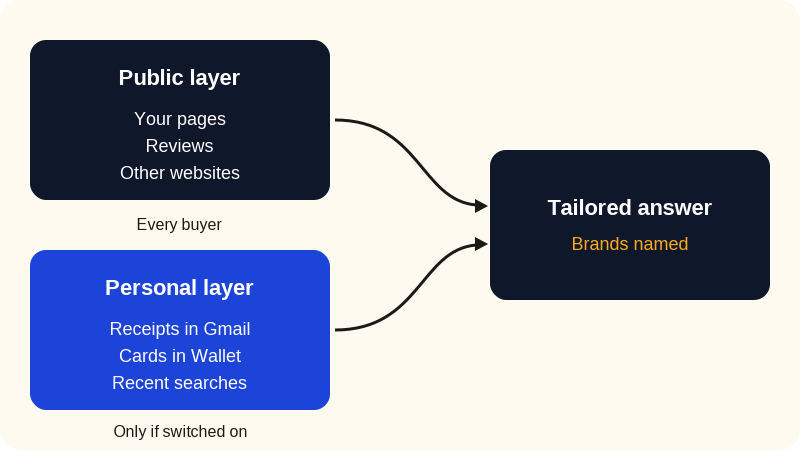
Our reading, which Google does not state: a tailored answer now has two layers.
- The public layer is what the web says about you: your pages, reviews, comparisons and other sites. Every buyer, including new ones, meets this layer.
- The personal layer is the buyer's own history: receipts in Gmail, cards in Wallet, recent searches. It can only help a brand the person already knows.
What does Google not say yet?
Google's posts leave the size of the effect open. They do not say how much personal context outweighs web results, whether tailored answers show the same links, or which questions get personalized. The 23 November post also gives no eligibility details for the Wallet connection.
Some limits are stated. Google's March 2026 post said Personal Intelligence was for personal Google accounts, not Workspace business, enterprise or education accounts, and that AI Mode had it then in one market. Both the March and 23 November posts say people choose whether to connect apps and can turn connections off at any time.
The 23 November post says a Personalization icon below each tailored answer will soon show the context AI Mode used. Until it ships, nobody outside Google can see why a given person got a given brand.
What does this mean for measuring AI visibility?
A clean check, asked without personal history, measures the public layer only. It is still the right baseline, because it is the answer a new buyer with no history gets, and it can be repeated. It is no longer a picture of what every buyer sees.
Answers already change from run to run. Personal context adds a second reason two people get different answers. Our guide on how to measure AI visibility explains why one screenshot misleads; personalization makes that point stronger. Report results as a share of many questions, asked the same way, with the date.
Who is most affected?
Brands that buyers return to are most exposed to the personal layer, by our reading of Google's examples: repeat purchases, devices that need support, cards and subscriptions. A brand a person already bought from has context in their receipts and spending. A challenger brand has none, so it must be named in the public layer.
Questions in regulated areas, such as which card or account to use, may now be answered against a person's own accounts. Google says Wallet access is read-only and cannot move money. If you work in finance, read Google's posts in full and check with a compliance professional before drawing conclusions.
What to do this week
- Keep your clean AI visibility checks, and label them as measuring the public answer, with the date and the questions asked.
- Ask your top three buyer questions in AI Mode twice, once with personalization on and once off in Search settings, and note any brand that changes.
- Check that order confirmations and receipts name your brand and the exact product model in plain text, since Google's examples read purchase receipts.
- Make sure support pages for each product model are public and indexable, so a tailored support answer has a page of yours to use.
- Work on the public layer for new buyers: our guide on how AI assistants decide which brands to name covers the third-party sites that shape it.
Frequently asked questions
Is Personal Intelligence switched on for everyone?
No. Google's posts say people choose if and when to connect apps, and can turn each connection on or off at any time. Google's March 2026 post said Personal Intelligence was for personal Google accounts, not for Workspace business, enterprise or education users.
Can I see what personal context Google used for an answer?
Not yet. Google's post of 23 November 2026 says a Personalization icon below each tailored response will show the context AI Mode used, and calls it coming soon. Until then, the only way to compare is to ask the same question with personalization on and off.
Does a personal answer still link to websites?
Google's posts do not say. They describe what personal context is added, not how much it changes the web results or the links shown. Treat the size of the effect as unknown until Google or an independent study says more.
Can a brand pay or apply to be part of someone's personal context?
Nothing in Google's posts describes a way for brands to join. The context comes from the person's own apps, such as Gmail, Photos, Calendar and Wallet, and from their recent searches.
Sources
Every figure and claim above comes from one of these pages. We opened each one on the day shown above.
- A more tailored Google Search that's uniquely yours, Google, 23 November 2026
- Bringing the power of Personal Intelligence to more people, Google, 17 March 2026
- Connect Google Wallet to Gemini for personal finance insights, Google, 13 November 2026
- Google: Connect Apps To Search In Return For Personal Responses, Search Engine Roundtable, 23 November 2026
About the author
Shubham Gururani
Founder, Opal AEO
Shubham Gururani is the founder of Opal AEO. He has been in Bitcoin since 2015 and has worked in web3 since 2021. Before that he spent years at Airtel selling data centre, security and network services to businesses. Since 2021 he has been an independent full-time trader of crypto and the stock market, and he has been learning and building with AI. He started Opal AEO to show businesses what AI assistants say about them when customers ask what to buy.
About Opal AEO
About Opal AEO
Opal AEO shows how often AI assistants name your brand when people ask buying prompts, what they say about it, and which websites they rely on. It is made for any brand that people research with an AI assistant before they buy.
This post was researched and drafted by an AI agent, then checked automatically against its sources before it was published. A person has not read it first. Nobody can promise how an AI assistant will answer, so nothing here is a guarantee.
More from the blog
- What changed in AI search and AEO, 20 to 27 November 2026Google explained how AI Overviews and AI Mode pick links, rewrote its AI controls and listed 12 more crawlers. Cloudflare launched search for AI agents.
- Does schema markup get AI to cite your brand? The evidenceGoogle says no special schema is needed for its AI features, and a 1,885-page Ahrefs test found no clear citation lift. What is known, and what to do.
- How to write a company facts sheet that AI can readA one-page facts sheet, matched to your Organization markup, gives AI one consistent set of company facts to read. Here are the steps to finish this week.