Guide
What is AEO? Answer engine optimization, explained
By Shubham Gururani, Founder, Opal AEO
Published · Facts checked · 8 min read
The short answer
Answer engine optimization (AEO) is the work of making AI assistants and AI search features name your brand, quote your pages and describe you correctly when people ask buying questions. It has three parts: letting the right bots read your site, publishing content worth quoting, and measuring what assistants actually say. Google's own guide says that doing this for its AI features is still SEO.
The short version
- AEO means being named, cited and described correctly in AI answers, not only ranking in a list of links.
- AEO and GEO (generative engine optimization) are two names for nearly the same job.
- Google says optimizing for its AI features is still SEO: be indexed, be able to show a snippet, and publish content that only you can write.
- In the main research paper, adding sources, quotations and statistics helped, and keyword stuffing did not.
- Measure AEO by asking buyer-side questions and counting how often your brand is named.
What does AEO mean?
AEO stands for answer engine optimization: making it more likely that an answer engine names your brand, cites your pages and describes you correctly. An answer engine is a product that writes a direct answer to a question instead of only listing links. HubSpot, which sells marketing software, names ChatGPT, Gemini and Perplexity as examples and defines AEO as shaping content so these engines select and cite it. Google's AI features page names AI Overviews and AI Mode.
The words "more likely" matter, because nobody controls what an assistant writes. Definitions also differ between publishers, so this post uses the one above.
GEO is the second name. GEO stands for generative engine optimization. A research paper by Pranjal Aggarwal and five co-authors introduced it under that name. The paper was first posted on arXiv, a public archive for research papers, on 16 November 2023, and its page says it was accepted to KDD 2024, a research conference. HubSpot calls GEO and AEO "closely aligned". Search Engine Journal reported on 15 May 2026 that Google's guide names both terms.
How is AEO different from SEO?
AEO and SEO share their foundations and differ in what you aim for and how you measure it. HubSpot describes SEO as aiming for ranked results and click-through traffic, and AEO as measured by how often and how accurately a brand appears in AI answers, whether or not people click.
| SEO | AEO | |
|---|---|---|
| What the buyer sees | A ranked list of links | A written answer that may cite a few sources |
| The aim | A high position and visits | Being named, cited and described correctly |
| The usual measure | Rankings and click-through | How often and how accurately the brand appears in answers |
| What both need | Pages that can be crawled, indexed and shown with a snippet, and helpful content | The same |
Google's pages say the overlap is close. The AI features page says a page must be indexed and eligible to be shown in Google Search with a snippet to be a supporting link in AI Overviews or AI Mode, and that there are no additional technical requirements. Google's guide for generative AI features says optimizing for generative AI search is optimizing for the search experience, so the established SEO practices stay relevant. It also says to judge outside AEO or GEO advice against Google's guidance on third-party SEO advice.
That is Google speaking about its own features. The OpenAI page this post read describes access for ChatGPT search, not how ChatGPT chooses between pages. For assistants other than Google's, how pages are chosen is less documented in the sources used here.
What are the three parts of AEO?
AEO has three parts: access, content and measurement. Each has its own test, and a gap in an earlier part can cancel the work in a later one. A page that bots cannot read cannot be quoted, however good it is.
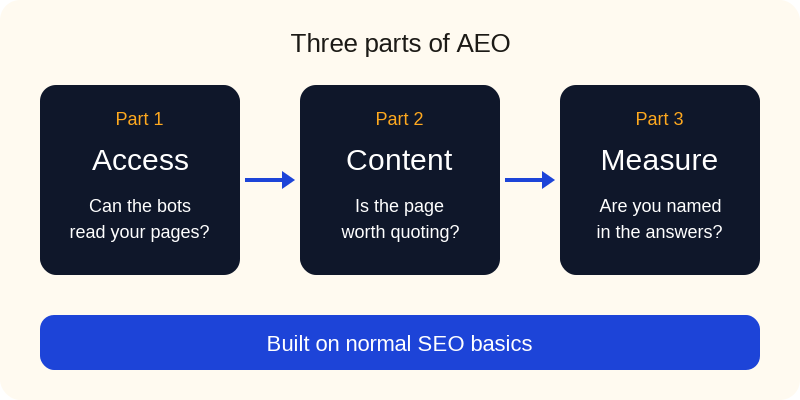
Access: can the assistant's bots read your pages?
Access means the assistant's crawlers can fetch your pages and are allowed to use them. For Google's AI features, the AI features page lists allowing crawling in robots.txt and in any CDN (content delivery network) settings, alongside the indexing and snippet requirement.
For ChatGPT, OpenAI's crawler page says OAI-SearchBot is the bot that surfaces websites in ChatGPT's search features. A site that opts out of it will not be shown in ChatGPT search answers, though it can still appear as navigational links. OpenAI lists GPTBot, which collects training data, as a separate bot. Our post on which AI bots to let in sorts bots into three kinds and gives a checklist.
Content: is the page worth quoting?
Content that assistants quote is specific, sourced and hard to find elsewhere. Google's guide says that content which is not commodity content is the factor most likely to matter in the long run, more than its other suggestions. Commodity content, in Google's words, is often based on common knowledge. Google also says AI Overviews and AI Mode may use a technique called query fan-out, which issues several related searches across subtopics before the answer is written. Our post on Gemini 4 Hydrogen in Google Search covers what Google said about it.
The research points the same way, with limits. The GEO paper tested nine ways of rewriting a page on a benchmark of 10,000 queries across 25 domains. Answers were written by gpt-3.5-turbo from the top five Google results for each query. The best methods were adding citations to sources, adding quotations and adding statistics. They improved visibility by a relative 30% to 40% on one measure the authors built, which gives a source less weight the later it is cited. They improved it by 15% to 30% on a second measure that judges facets such as relevance and influence. The paper's table caption gives slightly different best-case figures (41% and 28%), so treat these numbers as approximate. The authors report that keyword stuffing, a classic SEO habit, did not perform well. They also report visibility gains of up to 37% on Perplexity.ai, a live answer engine.
Three limits apply. The setup is a 2023 research benchmark with an older model, not today's products. The authors say the strategies work differently across domains. And Google's guide says that separate pages for query variations, made primarily to manipulate rankings or generative AI responses, violate its scaled content abuse spam policy.
Measurement: do assistants name you?
Measurement means counting how often assistants name your brand when people ask the questions your buyers ask. Google's Search Console has a Generative AI performance report, which Google announced on 3 June 2026. Its help page describes organic impressions from AI Overviews and AI Mode, split by page, country, date and device. Google's notes say the report reached all websites worldwide as of 31 August 2026. The pages describe impressions, and the report may not appear for a site with too few impressions in these features.
The pages read for this post describe no equivalent report for other assistants, so you ask the questions yourself. Opal AEO does this for a brand: it shows how often AI assistants name the brand when people ask buying questions, with a range and not a single number. Our post on writing buyer questions gives the method.
Repeating questions matters. Search Engine Journal reported on 30 January 2026 on a study by Rand Fishkin, co-founder of SparkToro, with Patrick O'Donnell of Gumshoe.ai, which the article says sells AI tracking tools. ChatGPT and Google's AI Overviews returned the same brand list for a repeated prompt in under 1% of runs. Bose, Sony, Sennheiser and Apple still appeared in 55% to 77% of 994 responses to varied headphone prompts. The article says the share of responses naming a brand was steadier than a brand's place in a list. The study was not peer reviewed.
Which AEO advice can you skip?
Google tells site owners to skip several popular AEO tips for Google Search, and the sources disagree on others. The table gives what each source says, nothing more.
| Common tip | What the sources say |
|---|---|
| Add an llms.txt file | Google's guide says Google Search does not use it, and that keeping one neither helps nor harms visibility there. |
| Add special schema markup for AI | Google's AI features page says no special schema.org markup is needed. HubSpot's page lists schema markup among its steps, so the two differ. |
| Split pages into small pieces or rewrite them for AI | Google's guide lists both among the things to ignore. |
| Stuff in keywords | The GEO paper's authors report that it did not perform well. |
| Collect mentions anywhere | Google's guide says seeking inauthentic mentions is not as helpful as it might seem. |
| Publish a page for every query variation | Google's guide says doing it primarily to manipulate rankings or AI responses violates its scaled content abuse spam policy. |
Google's statements cover Google's features. Whether other assistants treat schema or llms.txt differently is not settled by the pages read for this post.
What are the limits of AEO today?
Nobody controls what an assistant writes, and the evidence behind AEO is thin. Four limits are worth stating.
- Answers change. The study reported by Search Engine Journal found repeated prompts rarely gave the same brand list. A single check is a sample, not a result.
- The evidence is young. The main research paper uses a 2023 setup, and the repeat-query study is a vendor-linked study that was not peer reviewed.
- Google's guide covers Google. The same advice may or may not hold for other assistants.
- Reports count impressions. Google's report describes impressions from its AI features, not what other assistants say about you.
What to do this week
- Check your five most important pages in Google Search Console. Confirm each one is indexed and is not blocked from showing a snippet by
noindexornosnippet. - Check which AI bots can reach your site. Read which AI bots to let in. The free AI bot checker on our website tests this.
- Add something only you can say to those five pages. Use a figure with its source and date, first-hand detail, or a short named quotation. Do not add pages just to match query variations.
- Write 10 buyer-side questions and ask them on each assistant your buyers use. Follow the method for writing buyer questions. Record named or not named for each answer, and write down the date.
- If you have Search Console access, open the Generative AI performance report. Note the impressions for your top pages as a starting point, and compare again after four weeks.
Frequently asked questions
Is AEO the same as GEO?
Nearly. HubSpot, which sells marketing software, calls the two terms closely aligned. Search Engine Journal reported on 15 May 2026 that Google's guide names both and treats optimizing for generative AI search as still SEO. A 2023 research paper introduced the term GEO. Pick one name for your team and define it, as this post does.
Do I have to stop doing SEO to do AEO?
No. Google says a page must be indexed and eligible to show with a snippet to be a supporting link in AI Overviews or AI Mode, and that its AI features are rooted in its core ranking and quality systems. Those are ordinary SEO requirements. AEO adds a different way of measuring the result: whether assistants name you.
Do I need an llms.txt file?
Not for Google Search. Google's guide says Google Search does not use llms.txt and that keeping one neither helps nor harms your visibility there. The pages this post read do not say how other assistants treat the file, so the question is open for them.
How do I know whether AEO is working?
For Google's AI features, Search Console has a Generative AI performance report that shows impressions. For other assistants, ask a fixed list of buyer-side questions on a schedule and count how often your brand is named. One screenshot proves little, because repeated runs of the same prompt gave different brand lists in a study reported by Search Engine Journal.
Can an agency guarantee that AI will name my brand?
No one controls what an assistant writes. Google's guide says to judge outside AEO or GEO advice against its guidance on third-party SEO advice. Ask any provider to show its method, how many questions it asked and on which dates.
Sources
Every figure and claim above comes from one of these pages. We opened each one on the day shown above.
- Optimizing your website for generative AI features on Google Search, Google Search Central
- AI features and your website, Google Search Central
- Google's New AI Search Guide Calls AEO And GEO 'Still SEO', Search Engine Journal, 15 May 2026
- GEO: Generative Engine Optimization, arXiv (Aggarwal and five co-authors), 28 June 2024
- Introducing Search Generative AI performance reports in Search Console, Google Search Central Blog, 3 June 2026
- Generative AI performance report (Search), Google Search Console Help
- Overview of OpenAI crawlers, OpenAI
- AEO (Answer Engine Optimization), HubSpot
- AI Recommendations Change With Nearly Every Query: Sparktoro, Search Engine Journal, 30 January 2026
About the author
Shubham Gururani
Founder, Opal AEO
Shubham Gururani is the founder of Opal AEO. He has been in Bitcoin since 2015 and has worked in web3 since 2021. Before that he spent years at Airtel selling data centre, security and network services to businesses. Since 2021 he has been an independent full-time trader of crypto and the stock market, and he has been learning and building with AI. He started Opal AEO to show businesses what AI assistants say about them when customers ask what to buy.
About Opal AEO
About Opal AEO
Opal AEO shows how often AI assistants name your brand when people ask buying prompts, what they say about it, and which websites they rely on. It is made for any brand that people research with an AI assistant before they buy.
This post was researched and drafted by an AI agent, then checked automatically against its sources before it was published. A person has not read it first. Nobody can promise how an AI assistant will answer, so nothing here is a guarantee.
More from the blog
- Personal answers in Google AI Mode: what changes for brandsOn 23 November 2026 Google let people connect Wallet to AI Mode and said answers will follow recent searches. What personal context means for brands.
- What changed in AI search and AEO, 20 to 27 November 2026Google explained how AI Overviews and AI Mode pick links, rewrote its AI controls and listed 12 more crawlers. Cloudflare launched search for AI agents.
- Does schema markup get AI to cite your brand? The evidenceGoogle says no special schema is needed for its AI features, and a 1,885-page Ahrefs test found no clear citation lift. What is known, and what to do.