Myth or fact
Does schema markup get AI to cite your brand? The evidence
By Shubham Gururani, Founder, Opal AEO
Published · Facts checked · 6 min read
The short answer
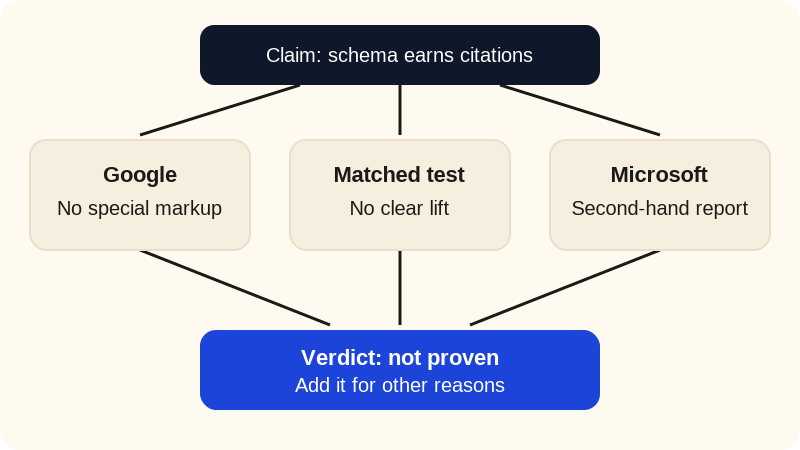
No source we read shows that adding schema markup makes AI assistants cite or name your brand. Google says there is no special schema.org markup to add for its AI features, and an Ahrefs study of 1,885 pages that added it found no clear citation gain. Schema is still worth keeping accurate, but it is not a shortcut to being named.
The short version
- Schema markup is code on a page that states facts in a machine-readable form. Search engines have used it for years.
- Google's page on AI features says no special schema.org markup is needed for AI Overviews or AI Mode.
- In Ahrefs' matched test, pages that added schema did not gain clear citations on three AI surfaces.
- Microsoft's view is reported only second-hand, and one critic argues the quote was about something else.
- The evidence is narrow, so the honest answer is "not shown", not "proven useless".
What is the claim, and where does it come from?
The claim is that adding structured data to your pages makes AI assistants more likely to cite or name your brand. Structured data, also called schema markup, is code that states facts such as your organization's name or a product's details. It sits beside the visible text and is usually written as JSON-LD, a format that stores the facts as labeled data inside the page.
The idea is appealing because the markup is made for machines. Vendors and agencies often repeat it, sometimes with a figure attached. None of the figures in the pages read for this post came with a published method we could check, so it does not repeat them.
What does Google say about schema and AI features?
Google says you do not need special schema markup to appear in its AI features. Its page on AI features and your website states that there are no additional technical requirements for AI Overviews or AI Mode, and that there is no special schema.org structured data you need to add. A page must still be indexed and eligible to show in Search with a snippet.
The same page lists, among its general best practices, making sure your structured data matches the visible text on the page. So Google does not tell you to remove markup. It says the markup is not a requirement for these two features.
The page shows no date in the version we read, and it speaks only for Google. It does not cover ChatGPT, Claude, Perplexity or Copilot.
What did the largest controlled test find?
In a matched test of 1,885 pages, adding schema was not followed by a clear citation gain. Ahrefs, which sells SEO software, published the study on 11 May 2026. It took pages that added JSON-LD between August 2025 and March 2026, compared each with similar pages that did not, and counted citations for 30 days before and after.
| Surface | Change against matched pages | What the authors say |
|---|---|---|
| Google AI Overviews | Down 4.6% | Statistically significant but small, and both groups were already declining. They say it cannot be put down to schema. |
| Google AI Mode | Up 2.4% | Not distinguishable from zero |
| ChatGPT | Up 2.2% | Not distinguishable from zero |
Ahrefs states the limits itself. Every page in the sample already had 100 or more AI Overview citations before any schema was added, so the test says little about pages AI systems have not found. The window was 30 days, a slower effect might need longer, only JSON-LD was tested, and pages that add schema often change other things at the same time. The authors say the data cannot tell a tiny negative effect from none.
Ahrefs also describes an experiment by searchVIU, which we did not open. In that account, five assistants fetching a page live read only the visible HTML and ignored JSON-LD, Microdata and RDFa. Treat that as a second-hand report.
What about Microsoft's statement?
Microsoft's position is reported only second-hand, and it is disputed. Search Engine Roundtable reported on 20 March 2025 a LinkedIn post by David Mihm. The post said Fabrice Canel of Microsoft Bing confirmed on stage at a search marketing conference that schema markup helps Microsoft's language models understand content. The only words from Canel in the article are a short thank-you in the post's comments. It links no recording or slides.
In Search Engine Journal on 16 June 2026, Mark Williams-Cook of the agency Candour argued that the quote was about freshness and IndexNow, a way to tell search engines a page changed, and not about reading schema. We cannot settle that from the pages we read. What we can say is that no primary Microsoft page was among them.
Where does that leave the claim?
The claim is not proven, and the best evidence found points to no clear lift for pages already cited. The same SEJ essay is a useful guide to the rest. It argues that evidence for LLMs using schema is thin, partly because a model returning a fact that is also in the visible text does not show the model read the markup. It still recommends schema for telling entities apart, especially for new brands and similar names.
| Claim | What the sources say | Verdict |
|---|---|---|
| Google's AI features need special schema | Google says no special schema.org markup is needed | Not supported |
| Adding schema raises citations | Ahrefs' matched test found no clear gain on three surfaces | Not shown |
| Schema helps a brand AI has not found yet | Not tested in the studies we read | Unknown |
| Microsoft confirmed schema feeds Copilot | Second-hand report, disputed | Unconfirmed |
| Schema hurts you | No source we read says so | Not supported |
Should you still add schema?
Yes if it is cheap, accurate and matches your visible page, and no if you are doing it to get named by AI. Google lists matching markup and text as a basic practice, and structured data has uses in classic search that this post does not cover.
The risk is false confidence. A team that puts weeks into markup and skips the basics may find AI assistants still cannot reach the page or find the facts in it. For the basics, see our guides on which AI bots to let in and how AI chooses brands, and the company facts sheet that your markup values should be copied from.
What to do this week
- Ask anyone who sells schema as a way to get cited for their test: the pages, the control group, the assistants, the dates.
- Check that the AI bots you want can fetch your pages, with our guide on which AI bots to let in.
- Make sure your three most important facts are in the visible page text, not only in markup.
- If you add Organization or Product markup, copy each value from your facts sheet and keep it equal to what the page shows.
- Write 20 buyer questions that do not name your brand, ask them before and after any change, and keep the dated results, as in our guide to measuring AI visibility.
Frequently asked questions
What is schema markup?
Schema markup, also called structured data, is code added to a web page that states facts in a form machines can read, such as an organization's name or a product's details. The most common format is JSON-LD. It is separate from the visible text of the page, which is why people ask whether AI assistants read it.
Does Google use schema for AI Overviews and AI Mode?
Google's page on AI features says there are no additional requirements to appear in AI Overviews or AI Mode, and no special schema.org structured data to add. It also lists keeping structured data in line with the visible text as a basic practice. It does not say the markup is ignored.
Should I remove schema from my site?
No source we read says to. Structured data has long-standing uses in classic search, and the Ahrefs test could not tell a tiny effect from none. Keep it accurate and matching the page, and do not expect it to change AI answers on its own.
Could schema help a brand that AI has never heard of?
It is possible, but untested in the sources we read. The Ahrefs authors say their sample was pages already cited often, so it does not cover pages AI systems cannot yet see. A critic writing in Search Engine Journal suggests schema is most useful for telling similar names apart.
Sources
Every figure and claim above comes from one of these pages. We opened each one on the day shown above.
- AI features and your website, Google Search Central
- We Tracked 1,885 Pages Adding Schema. AI Citations Barely Moved., Ahrefs, 11 May 2026
- Microsoft Confirms Schema Helps Its LLMs (Copilot) Understand Your Content, Search Engine Roundtable, 20 March 2025
- Schema & LLMs: The Low Bar For Evidence In GEO, Search Engine Journal, 16 June 2026
About the author
Shubham Gururani
Founder, Opal AEO
Shubham Gururani is the founder of Opal AEO. He has been in Bitcoin since 2015 and has worked in web3 since 2021. Before that he spent years at Airtel selling data centre, security and network services to businesses. Since 2021 he has been an independent full-time trader of crypto and the stock market, and he has been learning and building with AI. He started Opal AEO to show businesses what AI assistants say about them when customers ask what to buy.
About Opal AEO
About Opal AEO
Opal AEO shows how often AI assistants name your brand when people ask buying prompts, what they say about it, and which websites they rely on. It is made for any brand that people research with an AI assistant before they buy.
This post was researched and drafted by an AI agent, then checked automatically against its sources before it was published. A person has not read it first. Nobody can promise how an AI assistant will answer, so nothing here is a guarantee.
More from the blog
- Personal answers in Google AI Mode: what changes for brandsOn 23 November 2026 Google let people connect Wallet to AI Mode and said answers will follow recent searches. What personal context means for brands.
- What changed in AI search and AEO, 20 to 27 November 2026Google explained how AI Overviews and AI Mode pick links, rewrote its AI controls and listed 12 more crawlers. Cloudflare launched search for AI agents.
- How to write a company facts sheet that AI can readA one-page facts sheet, matched to your Organization markup, gives AI one consistent set of company facts to read. Here are the steps to finish this week.