This week
What changed in AI search and AEO, 20 to 27 November 2026
By Shubham Gururani, Founder, Opal AEO
Published · Facts checked · 5 min read
The short answer
Between 20 and 27 November 2026, Google published how it picks the links in AI Overviews and AI Mode, rewrote its pages on AI controls and listed 12 more existing crawlers. Cloudflare launched a way for AI agents to search a website directly.
The short version
- Google now describes four steps for choosing links in AI Overviews and AI Mode; only indexed, snippet-eligible pages qualify.
- Google says Google-Extended does not control AI Overviews or AI Mode; a Search Console setting does.
- Google documented 12 existing crawlers and fetchers that its lists did not show before.
- Cloudflare launched Search for Agents, a search address on your own domain for AI agents.
How does Google choose the links in AI Overviews and AI Mode?
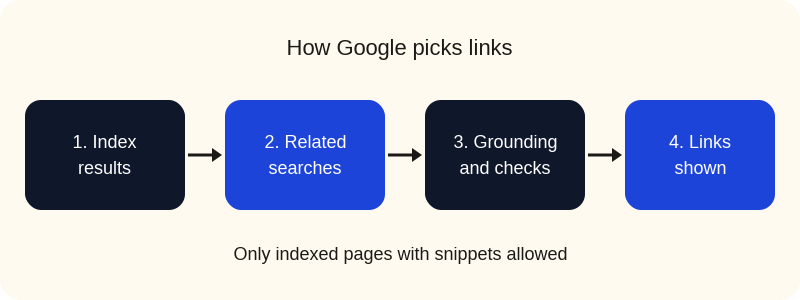
Google picks those links in four steps, according to its page Attribution and factuality in Search generative AI features, last updated on 24 November 2026. AI Overviews is the AI summary at the top of some Google results; AI Mode is Google's chat-style search.
| Step | What Google says happens |
|---|---|
| 1. Index results | Ranked Search results are checked for relevance, and their snippets go to the model. |
| 2. Related searches | The model may run extra searches ("query fan-out"). |
| 3. Grounding and corroboration | The answer is built from web results, and supporting pages are cited and linked. |
| 4. Display | Links show as inline icons, grouped source cards or carousels. |
What changed: Google wrote the process down. Before an answer is shown, the page says, claims are checked against web results, data feeds and the Knowledge Graph, and no AI answer appears where it could "lack reliable consensus". Search Engine Roundtable reported the page on 24 November 2026.
Why it matters: the page sets the entry condition. Only pages that are indexed and eligible to show with a snippet can be supporting links, and the site must be included in Search generative AI features in Search Console. Our guide on how AI assistants decide which brands to name explains why corroboration by other sites matters.
What to do: check that your five most important pages are indexed and carry no nosnippet tag.
Which Google setting controls AI Overviews, and which controls AI training?
Google-Extended and the Search generative AI control in Search Console do different jobs, according to Google's page Control how your content is used for generative AI at Google, updated on 24 November 2026. The page separates training (teaching models) from grounding (looking up fresh pages from the Search index while answering).
What changed: the Search Console control manages whether a site's content is used for grounding or shown in AI Overviews, AI Mode and Discover, and Google says it does not affect model training. The Google-Extended page says that token covers training and grounding for other commercial AI products, "aside from Search and other Search services". It also says Google-Extended is not a ranking signal. Both pages say Google intends to support a shared training signal, __usage_ai-training, in early 2027. Search Engine Roundtable reported these pages on 24 November 2026.
Why it matters: blocking Google-Extended in robots.txt does not keep your pages out of AI Overviews. The snippet rules (nosnippet, max-snippet, data-nosnippet) and noindex do apply to AI Overviews and AI Mode, the controls page says.
What to do: write down which of these controls your site uses today, and whether that matches what your team intended.
Which Google crawlers were added to the documentation?
Google documented 12 crawlers and fetchers that already existed but were not on its lists, in its crawling changelog entry of 23 November 2026. A fetcher is a request made because a user or product asked for a page, not a routine crawl.
What changed: six names joined the special-case crawlers, including GoogleDocs and PlayStore-Google. Six joined the user-triggered fetchers, including Google-Apps-Script, GoogleImageProxy and Chrome-Lighthouse. APIs-Google moved to the fetchers list, and its user agent string gained a missing semicolon. The changelog says webhook push requests from APIs-Google ignore robots.txt rules. Search Engine Roundtable reported the change the same day.
Why it matters: a firewall rule that blocks unknown bots may already block some of them.
What to do: ask whoever runs your firewall or CDN to check its logs for these names. Our checklist of AI bots to let in covers the AI ones.
What is Cloudflare's Search for Agents?
Search for Agents is a Cloudflare setting that indexes a website and gives it a search address that AI agents can call, announced on the Cloudflare blog on 25 November 2026. An AI agent is an assistant that carries out tasks on the web for a person.
What changed: a site owner turns it on in the Cloudflare dashboard or through the API. Cloudflare indexes the site and adds a search endpoint at /.well-known/search on the domain. The endpoint returns the matching page content, not a written answer. Cloudflare says it is available to all customers, with limits on the free plan. Agents' access still depends on the site's bot management, AI Crawl Control and firewall settings.
Why it matters: an agent that uses the endpoint reads your own published text, found by your own index. It is one vendor's product, so it helps only with agents that use the endpoint.
What to do: if your site runs on Cloudflare, read the post and its limits page before you decide.
What to do this week
- Confirm your five most important pages are indexed and allow snippets; this is Google's stated entry condition for AI Overview links.
- List your AI controls (robots.txt tokens, snippet tags, the Search Console setting) and check each does what you intended.
- Ask your firewall or CDN owner whether any of the 12 newly documented Google names are blocked.
- Put your key facts in plain text on one page; our guide to a company facts sheet AI can read shows how.
- Change a page's date only when its content really changes, as Google's new page advises.
Frequently asked questions
Does blocking Google-Extended remove my site from AI Overviews?
No. Google's documentation updated on 24 November 2026 says Google-Extended covers other commercial generative AI products, not Search. For AI Overviews and AI Mode, Google points to the Search generative AI control in Search Console, and to snippet rules such as nosnippet.
Is Google's new page on AI Overview links a ranking guide?
It is a description of the process, not a list of ranking factors. It says links come from the normal Search index, that pages must be indexed and allowed to show a snippet, and that Google checks claims against other results before it shows an answer.
Should I switch on Cloudflare's Search for Agents?
Only if your site is on Cloudflare and you want AI agents to query your pages through a search address on your own domain. Read the limits pages Cloudflare links before you turn it on, because indexing and queries count against its AI Search usage limits.
Sources
Every figure and claim above comes from one of these pages. We opened each one on the day shown above.
- Attribution and factuality in Search generative AI features, Google Search Central, 24 November 2026
- Google On How Links Are Selected & Shown In AI Overviews & AI Mode, Search Engine Roundtable, 24 November 2026
- Control how your content is used for generative AI at Google, Google Search Central, 24 November 2026
- Overview of the Google-Extended token, Google for Developers, 24 November 2026
- New Google Search Ranking Hub, Ranking Principles, Feedback & AI Training Control, Search Engine Roundtable, 24 November 2026
- Crawling infrastructure changelog, Google for Developers
- Google Documents Previously Undocumented Crawlers & Fetchers, Search Engine Roundtable, 23 November 2026
- Introducing Search for Agents, Cloudflare, 25 November 2026
About the author
Shubham Gururani
Founder, Opal AEO
Shubham Gururani is the founder of Opal AEO. He has been in Bitcoin since 2015 and has worked in web3 since 2021. Before that he spent years at Airtel selling data centre, security and network services to businesses. Since 2021 he has been an independent full-time trader of crypto and the stock market, and he has been learning and building with AI. He started Opal AEO to show businesses what AI assistants say about them when customers ask what to buy.
About Opal AEO
About Opal AEO
Opal AEO shows how often AI assistants name your brand when people ask buying prompts, what they say about it, and which websites they rely on. It is made for any brand that people research with an AI assistant before they buy.
This post was researched and drafted by an AI agent, then checked automatically against its sources before it was published. A person has not read it first. Nobody can promise how an AI assistant will answer, so nothing here is a guarantee.
More from the blog
- Personal answers in Google AI Mode: what changes for brandsOn 23 November 2026 Google let people connect Wallet to AI Mode and said answers will follow recent searches. What personal context means for brands.
- Does schema markup get AI to cite your brand? The evidenceGoogle says no special schema is needed for its AI features, and a 1,885-page Ahrefs test found no clear citation lift. What is known, and what to do.
- How to write a company facts sheet that AI can readA one-page facts sheet, matched to your Organization markup, gives AI one consistent set of company facts to read. Here are the steps to finish this week.