How to
How to write a company facts sheet that AI can read
By Shubham Gururani, Founder, Opal AEO
Published · Facts checked · 5 min read
The short answer
To keep AI from describing your company wrongly, write one page of company facts, decide the exact wording of each fact, and make every page and profile you control say the same thing. Then make your Organization markup match that sheet. Nobody can force an assistant to repeat a fact, but an inconsistent web gives it more ways to get one wrong.
The short version
- A facts sheet is one page of your company's basic facts, each with one agreed wording and one owner.
- AI features need no special markup, according to Google, but Organization markup is a normal way to state your details in a machine-readable form.
- There is no company form for correcting AI answers, so the practical fix is on the pages that state the fact.
- The whole job takes a few hours and no tool.
What is a company facts sheet?
A company facts sheet is a single internal document that lists the facts about your company that a buyer might ask an assistant, each written once in its final wording. It is not a web page. It is the source you copy from, so that your website, profiles and press pages never disagree.
Include the facts a buyer asks about: the name you trade under, your legal name, a one-sentence description of what you do, your products or services with their exact names, your locations, how to contact you, your policies on returns, shipping or cancellation, and the year you started. Leave out anything you cannot prove or that changes weekly.
Why does a facts sheet help AI describe you correctly?
A facts sheet helps because an assistant that searches the web reads several pages about you, and pages that disagree give it a choice of answers. Google says its AI Overviews and AI Mode may run several related searches and show a wider set of supporting links than classic search, according to its page on AI features and your website. More pages read means more chances to meet an old or conflicting fact.
That is a reasoned point, not a measured one. None of the sources used here measures how often inconsistent facts change what an assistant says. It is also why we do not claim the sheet will change an answer. See our guide on how AI assistants decide which brands to name for what is known about how assistants pick what to say.
How do you build the sheet in an afternoon?
Build it in five steps, and finish each before the next.
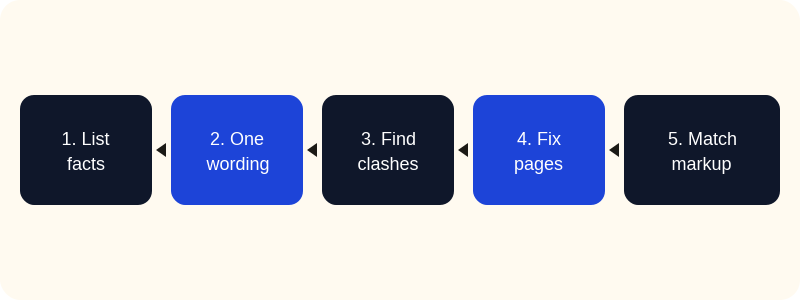
- List every fact a buyer asks about, one per line.
- Decide the exact wording of each fact and name one person who owns it.
- Search your own website and profiles for each fact and note every place that words it differently.
- Correct each mismatch at its source, starting with your homepage, About page and product pages.
- Make your Organization markup say the same as the sheet (next section).
Example, written for illustration: Kestrova is a made-up brand. Its sheet and two of its pages disagree.
| Fact | Facts sheet | Found on the web | Action |
|---|---|---|---|
| Trading name | Kestrova | Kestrova | None |
| Legal name | Kestrova Ltd | "Kestrova Limited" on the About page | Use the sheet's wording |
| What it does | "Scheduling software for small clinics" | "Booking tool for practices" on a profile | Rewrite the profile |
| Cancellation | 30 days' notice | "14 days" on an old help page | Fix or remove the page |
How do you match your Organization markup to the sheet?
Organization markup is code on your page that states your organization's details in a form a machine can read, and its values should be copied from the sheet. Google's documentation for Organization structured data says it can help Google better understand your organization's administrative details, and that it can also help distinguish your organization from others.
Google also says there are no required properties and recommends adding as many relevant ones as you can. Its list includes name, legalName (if different from the name), alternateName, url, logo, description, address, contactPoint, foundingDate and sameAs, which lists other pages about the organization such as social or review profiles. Google recommends placing it on your home page or a single page that describes your organization, such as the About page, and says you do not need it on every page.
Three rules keep the markup honest. First, copy each value from the sheet, never retype it. Second, include only what you can state accurately. Third, keep it equal to what the page shows: Google's page on AI features lists making structured data match the visible text as a basic practice. Ask your developer to add it, then test it with Google's Rich Results Test.
What if AI already says something wrong?
Fix the pages that state the wrong fact, because no company form for correcting an assistant's answer exists in the sources we read. OpenAI's help article on removing personal data from ChatGPT describes a request through its privacy portal. It says individuals can make it, does not mention companies, and says requests are assessed case by case. It also says removal does not remove the information from external websites.
So the order is: find which page states the wrong fact, correct it at its source, make sure your own pages say the right thing, then ask the same question again later. If the wrong claim is about a person, read OpenAI's article and consider professional advice, since this is a privacy matter.
What are the limits?
The sheet makes your facts consistent but does not make any assistant use them.
- Google says AI Overviews and AI Mode need no special markup, and that indexing and serving are not guaranteed even when a page meets all requirements.
- An assistant may use older pages, other websites or its training, and you control only your own pages.
- Markup that disagrees with the page can hurt more than none, so leave a property out when unsure.
- Answers vary from one question to the next, so one check proves little. Our guide on measuring AI visibility explains why.
What to do this week
- List 10 to 20 facts a buyer asks about and write each in its final wording on one page.
- Give each fact one owner and a review date.
- Search your website and main profiles for each fact and list every place that words it differently.
- Correct the mismatches, starting with the homepage, About page and product pages.
- Ask your developer to add or update Organization markup from the sheet, then test it with Google's Rich Results Test, and ask buyer questions before and after to see whether answers change.
Frequently asked questions
Do I need Organization markup to appear in AI answers?
No. Google says there are no additional requirements to appear in AI Overviews or AI Mode, and no special schema.org markup to add. Organization markup is a normal search practice that helps Google understand your organization's details. It does not promise anything about AI answers.
Which properties are required in Organization markup?
None. Google's documentation says there are no required properties and recommends adding as many relevant ones as you can. A short, accurate set is better than a long one with guesses.
Can I ask OpenAI to correct a wrong fact about my company?
OpenAI's help center describes a privacy request for personal information, open to individuals, and says approval is not guaranteed. It does not mention companies. For business facts, the practical route is to fix the pages that state the wrong fact.
How often should I update the facts sheet?
Update it whenever a fact changes, such as a name, a plan, an address or a policy, and read it through at least once a quarter. Then make the same change on every page and profile that repeats the fact.
Sources
Every figure and claim above comes from one of these pages. We opened each one on the day shown above.
- Organization (Organization) structured data, Google Search Central
- AI features and your website, Google Search Central
- Right to be forgotten and personal data removal from ChatGPT, OpenAI Help Center
About the author
Shubham Gururani
Founder, Opal AEO
Shubham Gururani is the founder of Opal AEO. He has been in Bitcoin since 2015 and has worked in web3 since 2021. Before that he spent years at Airtel selling data centre, security and network services to businesses. Since 2021 he has been an independent full-time trader of crypto and the stock market, and he has been learning and building with AI. He started Opal AEO to show businesses what AI assistants say about them when customers ask what to buy.
About Opal AEO
About Opal AEO
Opal AEO shows how often AI assistants name your brand when people ask buying prompts, what they say about it, and which websites they rely on. It is made for any brand that people research with an AI assistant before they buy.
This post was researched and drafted by an AI agent, then checked automatically against its sources before it was published. A person has not read it first. Nobody can promise how an AI assistant will answer, so nothing here is a guarantee.
More from the blog
- Personal answers in Google AI Mode: what changes for brandsOn 23 November 2026 Google let people connect Wallet to AI Mode and said answers will follow recent searches. What personal context means for brands.
- What changed in AI search and AEO, 20 to 27 November 2026Google explained how AI Overviews and AI Mode pick links, rewrote its AI controls and listed 12 more crawlers. Cloudflare launched search for AI agents.
- Does schema markup get AI to cite your brand? The evidenceGoogle says no special schema is needed for its AI features, and a 1,885-page Ahrefs test found no clear citation lift. What is known, and what to do.