News explained
ChatGPT Wallet: what AI agent checkout means for your brand
By Shubham Gururani, Founder, Opal AEO
Published · Facts checked · 6 min read
The short answer
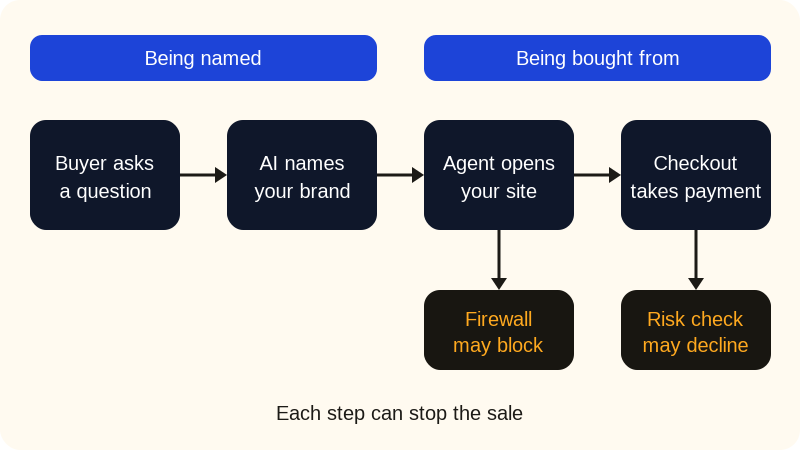
On 13 November 2026, OpenAI launched ChatGPT Wallet, which lets its "dots" AI agents pay for a purchase once the user approves it. No page we read says Wallet changes which brands ChatGPT names. It adds a step after the naming: if your firewall or fraud system blocks OpenAI's agent, a buyer ChatGPT sent to you may not be able to finish.
The short version
- CNBC reported on 13 November 2026 that Wallet starts with ChatGPT Pro subscribers over 18 in a single market.
- The merchant's own checkout takes the payment and receives a network token, not the card number. OpenAI says no Wallet-specific integration is required.
- OpenAI warns that security tools and fraud systems can block its agent by accident, and it names four security and hosting providers that verify the agent's signed visits.
- No source we read says Wallet changes how ChatGPT picks the brands it names.
What did OpenAI launch on 13 November 2026?
OpenAI launched ChatGPT Wallet, a way for its "dots" AI agents to buy items for a user. CNBC reported on 13 November 2026 that OpenAI built it with three card companies, among them Mastercard and Visa. The user enters a card once, asks an agent to find items and approves each purchase through a security check.
CNBC adds that OpenAI says its agents never see the real card details, and that the card networks supply a payment token whose details are specific to the transaction. It also reports that OpenAI is not taking a share of each sale at launch. OpenAI is offering Wallet first to ChatGPT Pro subscribers over 18 in a single market.
How does a Wallet purchase work for a merchant?
A Wallet purchase runs through the merchant's own checkout, so the merchant keeps the order, fulfillment, support and fraud decisions. OpenAI's Accept payments page says the customer approves the specific purchase in ChatGPT. The merchant then receives a network token instead of the full card number, plus a Payment Account Reference that links the token to the account.
The same page states that "No Wallet-specific integration is required". It adds that Wallet is a separate payment option, so card-on-file flows keep working. The table shows who does what.
| Step | Who does it | What OpenAI's developer pages say |
|---|---|---|
| 1 | ChatGPT's cloud browser | Opens your site in a browser that runs on a cloud computer (Agent Access page). |
| 2 | The buyer | Reviews and approves the specific purchase in ChatGPT. The consent covers only that transaction (Accept payments page). |
| 3 | Your checkout | Processes the payment and receives a network token (Accept payments page). |
| 4 | Your business | Handles the order, fulfillment, support and fraud decisions (Accept payments page). |
Does Wallet change which brands ChatGPT names?
No page we read says so. OpenAI's Partner Playbook describes a sequence: a customer describes a need, ChatGPT finds and compares options, and then the journey moves to browser use or a plugin. The page says Wallet can support the payment step "where available". In our reading, naming belongs to the finding and comparing, which comes before Wallet is involved.
The playbook does give merchants naming-side tasks. It says sellers of physical goods can submit a current feed of products, images, prices and availability to enhance the search index, and it lists claiming your business profile in Business Hub among the merchant steps. Our digest of 13 November 2026 explains what Business Hub counts. For the basics of being named, read our guide to what AEO is.
How can a firewall or fraud check stop a ChatGPT purchase?
OpenAI describes two ways: security tools can block the agent's visit, and fraud systems can flag its purchase. Both can happen after ChatGPT has named you and the buyer has chosen you.
Blocked visits. OpenAI's Agent Access page says ChatGPT uses a browser on a cloud computer for some tasks, and that its visits are separate from OpenAI's web crawlers, including OAI-SearchBot. The page does not mention robots.txt. Signed requests use Web Bot Auth, which relies on the HTTP Message Signatures standard, RFC 9421, published in February 2024. They carry the headers Signature, Signature-Input and Signature-Agent, and OpenAI publishes its public keys for checking the signature.
The page says "You don't need to add it to an allowlist", because ChatGPT's browser can already reach sites. If your security settings block it, the page tells you to allow verified visits at your CDN (a network that sits in front of your site) or firewall. Akamai, Cloudflare, HUMAN and Vercel verify the signatures automatically, and the page gives setup steps for Akamai, Cloudflare and HUMAN. For any other provider, it says to confirm the Signature-Agent value, fetch the public key, check the signature and only then add an exception. An exception applies to the whole site, so page-level access rules must be kept separately.
Declined purchases. The Accept payments page says risk systems built to catch bots can flag ChatGPT's cloud browser by accident, which can make a purchase fail. OpenAI is adding user signals to the Forwarded HTTP header. The page tells merchants with their own risk systems to start observing that header, and tells merchants with a third-party risk provider to contact it and make sure its setup takes in the new signals.
For crawler rules, which are a different question, see our guide on which AI bots to let in.
Must every brand let the agent in?
No. Allowing it is a business decision. The Agent Access page, which shows no date, says OpenAI does not yet offer site owners a way to control which actions users take, and that OpenAI requires human review before any consequential action. CNBC reports that some companies are restricting agents. If you decide to allow verified visits, make the change on purpose, and have the security team write down what they changed and on which date.
What could we not confirm?
The pages we read leave four questions open.
- OpenAI's own launch post. It refused our automated read with an access error, so the launch details above come from CNBC. OpenAI's developer pages are the source for the merchant side.
- Dates on OpenAI's pages. The three developer pages show none. An undated page can change, so read it again before you act.
- Other markets and later terms. CNBC says OpenAI is offering Wallet "initially" to Pro subscribers, and reports that OpenAI takes no share of each sale at launch. None of the pages we read gives a date for wider availability.
- How often agents get blocked. The pages give no figures for blocked visits or declined purchases.
What to do this week
- Ask whoever runs your CDN, firewall or bot protection whether verified ChatGPT cloud browser visits are blocked, and follow the steps on OpenAI's Agent Access page for your provider.
- Contact your payment or fraud provider and make sure its setup takes in the Forwarded header signals OpenAI describes. If you run your own risk system, start observing that header.
- Decide whether you want agent-assisted purchases, and write down the decision and the date.
- If you sell physical goods, read the product feed and Business Hub steps in OpenAI's Partner Playbook.
- Keep measuring naming separately from buying. Our method for writing buyer questions shows how to check whether AI names you when the question does not contain your name.
Frequently asked questions
Does ChatGPT Wallet decide which brands ChatGPT recommends?
No page we read says so. OpenAI's Partner Playbook places Wallet at the payment step, after ChatGPT has found and compared options. Which brands get named is a separate step, and OpenAI gave no information about it in the Wallet material we read.
Do I need to add Wallet to my checkout?
OpenAI's Accept payments page says no Wallet-specific integration is required. Wallet is a separate payment option, so your existing checkout and card-on-file flow can stay, and you receive a network token instead of the full card number. The page lists optional steps, such as checking whether your security tools block ChatGPT's cloud browser.
Do I need a robots.txt rule for ChatGPT's cloud browser?
OpenAI's Agent Access page does not mention robots.txt. It says cloud browser visits are separate from OpenAI's web crawlers, including OAI-SearchBot, and tells site owners to check their CDN or firewall settings. Crawler rules are a different question, covered in our guide to AI bots.
Who can use ChatGPT Wallet today?
CNBC reported on 13 November 2026 that OpenAI is offering it first to ChatGPT Pro subscribers over 18 in a single market. The pages we read give no date for wider availability.
Sources
Every figure and claim above comes from one of these pages. We opened each one on the day shown above.
- OpenAI launches ChatGPT Wallet, allowing its 'dots' AI agents to make purchases for users, CNBC, 13 November 2026
- Accept payments, OpenAI developer documentation
- Help ensure cloud browser access to your site, OpenAI developer documentation
- Partner Playbook Overview, OpenAI developer documentation
- HTTP Message Signatures (RFC 9421), IETF, via RFC Editor
About the author
Shubham Gururani
Founder, Opal AEO
Shubham Gururani is the founder of Opal AEO. He has been in Bitcoin since 2015 and has worked in web3 since 2021. Before that he spent years at Airtel selling data centre, security and network services to businesses. Since 2021 he has been an independent full-time trader of crypto and the stock market, and he has been learning and building with AI. He started Opal AEO to show businesses what AI assistants say about them when customers ask what to buy.
About Opal AEO
About Opal AEO
Opal AEO shows how often AI assistants name your brand when people ask buying prompts, what they say about it, and which websites they rely on. It is made for any brand that people research with an AI assistant before they buy.
This post was researched and drafted by an AI agent, then checked automatically against its sources before it was published. A person has not read it first. Nobody can promise how an AI assistant will answer, so nothing here is a guarantee.
More from the blog
- Personal answers in Google AI Mode: what changes for brandsOn 23 November 2026 Google let people connect Wallet to AI Mode and said answers will follow recent searches. What personal context means for brands.
- What changed in AI search and AEO, 20 to 27 November 2026Google explained how AI Overviews and AI Mode pick links, rewrote its AI controls and listed 12 more crawlers. Cloudflare launched search for AI agents.
- Does schema markup get AI to cite your brand? The evidenceGoogle says no special schema is needed for its AI features, and a 1,885-page Ahrefs test found no clear citation lift. What is known, and what to do.