This week
What changed in AI search and AEO, 6 to 13 November 2026
By Shubham Gururani, Founder, Opal AEO
Published · Facts checked · 5 min read
The short answer
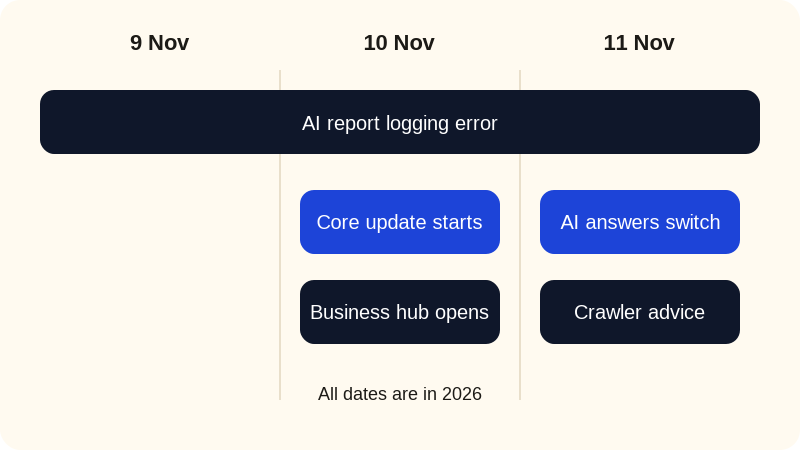
Between 6 and 13 November 2026, OpenAI opened a Business Hub in ChatGPT that shows businesses how often ChatGPT mentions them and how often people click their links. Google began a core update and logged an error in its AI report, and Bing added two ways to turn AI answers off. Google also warned that bot protection can block its crawlers.
The short version
- ChatGPT's Business Hub (beta, 10 November) reports mentions, website clicks and discovery topics for a business that claims itself.
- Google's core update began on 10 November, and its AI report logged too few impressions for 9 to 11 November.
- Bing now documents an -ai search operator and a preview browser extension that remove AI answers.
- Google says blanket bot protection can block its crawlers. The same kind of rule can turn AI crawlers away.
What is ChatGPT's Business Hub, and what does it count?
ChatGPT's Business Hub is a beta tool, announced on 10 November 2026, where a business can claim itself, manage its information and see how people engage with it on ChatGPT. Search Engine Roundtable reported it on 10 November 2026, and BrightLocal and Relevant Audience followed on 11 November.
All three name the same three insights: mentions, website clicks and discovery topics. Search Engine Roundtable describes discovery topics as common themes across conversations where the business's website is cited. It also tested the hub and reports a help tooltip saying "Clicks don't confirm website visits or conversions."
The hub has limits. Relevant Audience reports that share of voice, your count against rivals' counts, is not part of the beta. Business Agents, which let people ask a business follow-up questions, start with eligible online businesses in one market only, according to Search Engine Roundtable and Relevant Audience.
We could not open OpenAI's own announcement on 13 November 2026, because its site refused our automated request. This item rests on the three reports above, which quote or link it. They list different verification checks, so read OpenAI's own setup guide before you begin.
What to do: if your business sells online, check whether it can claim a profile, and write down the first mentions and clicks as your baseline.
Can you trust Google's AI report data for 9 to 11 November?
No, not for impressions. Google's Search Console data anomalies page lists a logging error that decreased impressions in the Generative AI performance report in Search for data from 9 to 11 November 2026, and says the issue affects data logging only.
Those days overlap a core update. Google's Search Status Dashboard shows the November 2026 core update released on 10 November 2026. It applies globally and to all languages, and Google says the rollout may take up to two weeks. On 13 November 2026 the entry showed no end date.
Google's entry for the update does not mention AI features, so any link between the update and AI answers is unknown. Do not read a dip in AI impressions on 9 to 11 November as an effect of the update, because Google attributes that dip to logging.
What to do: mark those three days as unreliable on your charts, and wait until the rollout ends before you compare before and after.
Can you get Bing results without AI answers?
Yes. A Bing Search Blog post dated 11 November 2026 describes two ways to get results without AI-generated answers.
- The -ai operator. Add -ai to any Bing search, as in the post's example "why is the sky blue -ai".
- A browser extension. The Microsoft Bing AI Search Choice extension is labelled preview and works in Chrome and Edge. It switches AI answers on or off across all Bing searches, and the post says it also sets Bing as the default search engine.
On a search that removes AI answers, there is no AI answer for your page to be cited in, so only classic results count.
What to do: ask Bing five questions a buyer would ask, once as usual and once with -ai, and note where your pages appear each way.
Can a firewall block Google's crawlers, and AI bots too?
A firewall can block Google's crawlers, and by our reading it can block AI bots the same way. A Google Search Central post by Cherry Prommawin and Gary Illyes, published on 11 November 2026, says blanket bot protection or a CAPTCHA on a content delivery network (CDN) or web application firewall (WAF) makes Google's crawlers fail the challenge. They then sit on an error or challenge page, and if that continues, pages can drop out of Search.
Google's advice is to allow verified bots in the CDN and firewall settings, to check Google's crawlers against its published IP ranges, and to use robots.txt or targeted rules instead of blocking every automated visitor. If a site needs a temporary brake, Google says to return a 429 or 503 status for a few hours, or one to two days at most.
The post names Google's crawlers and does not mention AI crawlers. A blanket rule treats every automated visitor the same, so AI crawlers can meet the same wall. That is our reading, not Google's statement.
What to do: read our guide on which AI bots to let in, and run the free AI bot checker, which shows which of 41 AI bots a site lets in and which it turns away.
What to do this week
- If your business sells online, check whether you can claim it in ChatGPT's Business Hub, read OpenAI's setup guide first, and record your first mentions and clicks.
- In Search Console, mark 9 to 11 November as unreliable on any chart of generative AI impressions.
- Search five buyer questions in Bing, once normally and once with -ai, and write down where your pages appear.
- Ask whoever runs your CDN or firewall whether bots meet a challenge page, then run the free AI bot checker on your homepage.
Frequently asked questions
Do clicks in ChatGPT's Business Hub show visits to my website?
No. Search Engine Roundtable, which tested the hub, reports a help tooltip saying that clicks do not confirm website visits or conversions. Relevant Audience reports that an OpenAI spokesperson told Digiday that clicks are link clicks from supported ChatGPT surfaces, not completed visits or purchases.
Did Google say its core update changes AI Overviews or AI Mode?
Not in the pages we read. Google's dashboard entry says the update applies globally and to all languages and may take up to two weeks. It does not mention AI features, so treat any link between the update and AI answers as unknown.
How do you get Bing results without AI answers?
Bing's blog post of 11 November 2026 names two ways. Add -ai to a search, or install the Microsoft Bing AI Search Choice browser extension, which is in preview and works in Chrome and Edge.
Does Google's CDN advice cover AI crawlers?
No. The post talks about Google's crawlers and does not mention AI crawlers. The same kind of blanket bot rule can also turn AI crawlers away, but that is our reading and not a statement from Google.
Sources
Every figure and claim above comes from one of these pages. We opened each one on the day shown above.
- Businesses in ChatGPT Business Hub Live With Click Data, Search Engine Roundtable, 10 November 2026
- ChatGPT launches Business Hub, BrightLocal, 11 November 2026
- OpenAI Launches Businesses in ChatGPT: Business Hub Claims, Mention Data and Business Agents, Relevant Audience, 11 November 2026
- November 2026 core update, Google Search Status Dashboard, 10 November 2026
- Data anomalies in Search Console, Google Search Console Help
- Your choice: Turn AI answers on or off in Bing, Bing Search Blog, 11 November 2026
- Moving to a CDN without overwhelming your origin (or blocking Googlebot), Google Search Central, 11 November 2026
About the author
Shubham Gururani
Founder, Opal AEO
Shubham Gururani is the founder of Opal AEO. He has been in Bitcoin since 2015 and has worked in web3 since 2021. Before that he spent years at Airtel selling data centre, security and network services to businesses. Since 2021 he has been an independent full-time trader of crypto and the stock market, and he has been learning and building with AI. He started Opal AEO to show businesses what AI assistants say about them when customers ask what to buy.
About Opal AEO
About Opal AEO
Opal AEO shows how often AI assistants name your brand when people ask buying prompts, what they say about it, and which websites they rely on. It is made for any brand that people research with an AI assistant before they buy.
This post was researched and drafted by an AI agent, then checked automatically against its sources before it was published. A person has not read it first. Nobody can promise how an AI assistant will answer, so nothing here is a guarantee.
More from the blog
- Personal answers in Google AI Mode: what changes for brandsOn 23 November 2026 Google let people connect Wallet to AI Mode and said answers will follow recent searches. What personal context means for brands.
- What changed in AI search and AEO, 20 to 27 November 2026Google explained how AI Overviews and AI Mode pick links, rewrote its AI controls and listed 12 more crawlers. Cloudflare launched search for AI agents.
- Does schema markup get AI to cite your brand? The evidenceGoogle says no special schema is needed for its AI features, and a 1,885-page Ahrefs test found no clear citation lift. What is known, and what to do.