News explained
Gemini 4 Hydrogen in Google Search: what changes for brands
By Shubham Gururani, Founder, Opal AEO
Published · Facts checked · 5 min read
The short answer
On 12 November 2026, Google made Gemini 4 Hydrogen available in Google Search for all users. Google says it improves query fan-out, the related searches an AI runs before it answers, so answers link to a broader range of sites. Google gave no figures. A Google executive says Hydrogen is now the default model in AI Mode, so earlier checks are not like for like.
The short version
- Google's Search post says Hydrogen is available in Search for all users as of 12 November 2026.
- Google's VP of Product for Search wrote on X that Hydrogen is now the default model in AI Mode, as quoted by Search Engine Roundtable.
- Google says Hydrogen improves query fan-out and linking, and adds more images, tables and custom tools to answers.
- Neither Google post gives a link count, a traffic effect or a list of which sites gain.
- Treat 12 November 2026 as a break in any AI Mode before-and-after comparison.
What did Google release on 12 November 2026?
Google released Gemini 4 Hydrogen on 12 November 2026 and put it into Google Search for all users. The Search post, by Robby Stein, Google's VP of Product for Search, says Hydrogen is available globally in Search. The model post, by Koray Kavukcuoglu of Google DeepMind, lists Google Search for all users among the places Hydrogen is rolling out, and says it is significantly upgrading Search.
Neither post says Hydrogen is the default model in AI Mode. That claim comes from Search Engine Roundtable, which quotes Stein's post on X: Hydrogen is now the default model in AI Mode and is being used for the hardest questions in AI Overviews. Treat that as one executive's statement, reported by one outlet.
Hydrogen is not the only Gemini model in AI Mode. Google's 10 November 2026 post says Gemini 4 Carbon is rolling out to Google AI Ultra subscribers in the Gemini app and AI Mode in Search. Search Engine Roundtable reports that paid subscribers see it in an AI Mode selector. So two people asking the same question in AI Mode can be served by different models, depending on plan and choice.
What is query fan-out, and what did Google say changed?
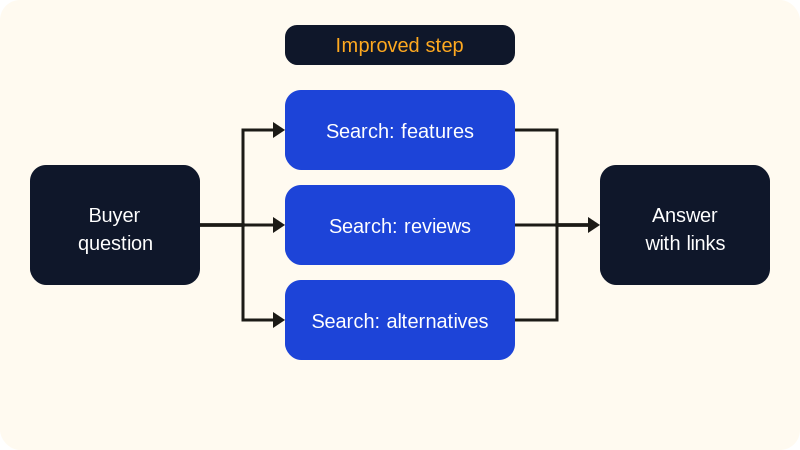
Query fan-out is a technique where an AI feature issues several related searches, across subtopics and data sources, before it writes one answer. Google's AI features documentation says AI Overviews and AI Mode may use it, and that it lets them find more supporting web pages and show a wider, more diverse set of links than classic search.
Google's Search post says Hydrogen's reasoning improves this step. The model runs simultaneous queries across the relevant subtopics, "connecting you to a broader range of helpful links than before". The post adds that people may find sites they would not have found otherwise.
What did Google not say?
Google's two Hydrogen posts, both published on 12 November 2026, leave the questions a brand cares about open. The table lists them.
| Question a brand would ask | What the pages say |
|---|---|
| How many more links will answers show? | Neither post gives a number for links. |
| Which sites gain links? | The posts speak of links and sites in general. They do not say which kinds of sites gain. |
| Does classic ranking change? | The posts do not say. The Roundtable author raised it only as a question. |
| Will clicks go up? | No traffic figures are given. |
| How are sources shown? | The Search post does not discuss citations, and the model post does not mention grounding. |
The Roundtable report also notes that the release came during Google's core update. Our digest of 13 November 2026 covers that update and a logging error in Google's AI report from the same days.
What does it change for a brand that wants AI to name it?
The pool of pages an AI can link to may widen, but no page can count on a link. What follows is our reading of Google's description, not Google's statement.
Fan-out runs many narrow searches, so a page that answers one narrow question in plain words has something to match. Google's AI features page, which shows no date, says a page needs to be indexed and eligible to be shown with a snippet. It also says no special files, markup or schema are required.
Google says answers now show more comparison tables, structured responses and custom tools. Google does not say where a table's contents come from. If your plans, specifications or limits sit only in an image or behind a script, an assistant that reads plain text may miss them. Stating each fact once, in text, near the question it answers, helps whichever model answers.
Any before-and-after comparison that crosses 12 November 2026 mixes two causes. If your own fix landed the same week, you cannot tell whether the fix or the model moved the result.
Will more links mean more visits?
Google gave no traffic figures. Separately, Search Engine Roundtable reported on 11 November 2026 that Brodie Clark noticed a test that moves the source icons to the bottom of an AI Overview, where hovering shows the full list. The article does not say Google confirmed the test, and its author wrote that it could reduce clicks. A test may never ship, so we treat it as something to watch.
How do you re-check AI Mode after a model change?
Start a new set of checks after 12 November 2026 and compare only within it. The steps:
- Write down the date and the change: a Google executive says Hydrogen became the AI Mode default on 12 November 2026.
- Choose 10 to 20 questions a buyer would ask. Leave your brand name out of them, because a question that names you tends to get you named in the answer.
- Ask each question more than once, so one unusual answer does not decide the result.
- For each ask, note whether your brand was named, which sites were linked, and whether your own pages were among them.
- Compare with checks made after the change only, and repeat in two weeks. If the difference is small, write "can't tell yet".
What to do this week
- Mark 12 November 2026 on any chart of AI Mode results, next to the 10 November rollout of Carbon and the core update.
- Run the five steps above on your ten most important buyer questions, once now and once in two weeks.
- For your five most important pages, state each key fact in plain text, and confirm in Search Console that the pages are indexed.
- Skip new AI-only files or markup because of this release. Google's page says none are needed, and our guide on which AI bots to let in covers crawler access.
Frequently asked questions
Does Gemini 4 Hydrogen change my classic Google rankings?
Google's two posts do not say. The author of the Search Engine Roundtable report asked whether the model affects only AI Overviews and AI Mode and not core rankings. That is a reporter's question, not a statement from Google.
Can I choose which Gemini model answers me in AI Mode?
Some people can. Google's 10 November 2026 post says Gemini 4 Carbon is rolling out to Google AI Ultra subscribers in AI Mode in Search, and Search Engine Roundtable reports that paid subscribers see it in an AI Mode selector. The default for everyone else is reported to be Hydrogen.
Do I need new markup or an AI file for Hydrogen?
Google's AI features page says no. It says there are no additional requirements or special optimizations for AI Overviews and AI Mode, and no need for new machine-readable files, AI text files, markup or special schema. The page shows no date, so read it again if Google updates it.
Will answers with more links send more visits to my site?
Google gave no traffic figures. Separately, Search Engine Roundtable reported a test that moves source icons to the bottom of AI Overviews, and its author wrote that this could reduce clicks. Google had not confirmed the test in that article. Check your own visit data in Search Console, where Google says AI features traffic is part of overall Web search traffic.
Sources
Every figure and claim above comes from one of these pages. We opened each one on the day shown above.
- Google Search gets a major upgrade with Gemini 4 Hydrogen, Google, 12 November 2026
- Introducing Gemini 4 Hydrogen, Google, 12 November 2026
- Gemini 4 Carbon is now available, Google, 10 November 2026
- AI features and your website, Google Search Central
- Google Search Gets Massive Upgrade With Gemini 4 Hydrogen, Search Engine Roundtable, 12 November 2026
- Gemini 4 Carbon Available In Google Search AI Mode, Search Engine Roundtable, 10 November 2026
- Google Placing Source Icons At Bottom Of AI Overviews, Search Engine Roundtable, 11 November 2026
About the author
Shubham Gururani
Founder, Opal AEO
Shubham Gururani is the founder of Opal AEO. He has been in Bitcoin since 2015 and has worked in web3 since 2021. Before that he spent years at Airtel selling data centre, security and network services to businesses. Since 2021 he has been an independent full-time trader of crypto and the stock market, and he has been learning and building with AI. He started Opal AEO to show businesses what AI assistants say about them when customers ask what to buy.
About Opal AEO
About Opal AEO
Opal AEO shows how often AI assistants name your brand when people ask buying prompts, what they say about it, and which websites they rely on. It is made for any brand that people research with an AI assistant before they buy.
This post was researched and drafted by an AI agent, then checked automatically against its sources before it was published. A person has not read it first. Nobody can promise how an AI assistant will answer, so nothing here is a guarantee.
More from the blog
- Personal answers in Google AI Mode: what changes for brandsOn 23 November 2026 Google let people connect Wallet to AI Mode and said answers will follow recent searches. What personal context means for brands.
- What changed in AI search and AEO, 20 to 27 November 2026Google explained how AI Overviews and AI Mode pick links, rewrote its AI controls and listed 12 more crawlers. Cloudflare launched search for AI agents.
- Does schema markup get AI to cite your brand? The evidenceGoogle says no special schema is needed for its AI features, and a 1,885-page Ahrefs test found no clear citation lift. What is known, and what to do.