News explained
Microsoft Web IQ: what AI agent web grounding means for brands
By Shubham Gururani, Founder, Opal AEO
Published · Facts checked · 5 min read
The short answer
Microsoft announced on 17 November 2026 that Web IQ, a web search service built for AI agents, is available to all Azure customers. One call searches the web, news, images and more, and returns only cited passages. For a brand, the questions are whether Microsoft's crawler can read your pages and whether an agent's builder has excluded you.
The short version
- Web IQ is a service developers use to give their AI agents fresh web passages with sources.
- Microsoft says it runs its own index and that its crawler, Bingbot, honors robots.txt.
- Organizations can set "Scopes": lists of sites an agent may use or must avoid.
- We could not confirm which assistants use Web IQ, or how a publisher opts out.
- The useful check is old and simple: can Bingbot read the pages that state your facts?
What is Microsoft Web IQ?
Web IQ is a web grounding service for AI agents, according to Microsoft's Tech Community post of 17 November 2026. Grounding means giving an AI model current pages to answer from, instead of relying only on what it learned in training.
The post says the service is now available to all Azure customers, Microsoft's cloud platform. Microsoft's Ignite 2026 Book of News repeats that it is generally available. Microsoft's Ignite overview describes "Microsoft IQ" as a platform that helps organizations feed business knowledge to apps and agents. It does not mention Web IQ by name.
The Book of News carries a banner saying its summaries were generated with the help of AI and may be incorrect. We used it only to confirm availability.
How does Auto mode choose what an agent reads?
Auto mode is the new default way to call Web IQ, and one call covers several kinds of content. The Tech Community post says a single call fans out across web, news, images, videos, local and weather, and "returns only cited passages." Fan-out means one question becomes several searches. Our guide to what AEO is explains why that shapes which pages get used.
An "Auto Advanced" setting runs repeated retrieval passes, the post says. Microsoft also states that every result links back to its original source.
Microsoft does not say how it ranks one page over another. The post says only that it controls how content is discovered and sourced. That is a vendor statement, not a method anyone can test from outside.
Where does the content come from, and can Bingbot read your site?
Microsoft says it builds and operates its own index, and that Bingbot, its publicly identified crawler, honors robots.txt. Both statements come from the Tech Community post. It names no separate crawler for Web IQ.
That makes the first check familiar. If your robots.txt or firewall blocks Bingbot, your pages may not be in the index that Web IQ draws on. The post does not state that every Web IQ result comes from Bingbot's crawl, so this is an inference from what Microsoft wrote, not a confirmed rule.
The post also says that since 30 October 2026, publishers can set page-level preferences for AI grounding. It gives no tag, header or setting name, so we could not verify how that works. Read Microsoft's own documentation before you change anything.
What are Scopes, and why should a brand care?
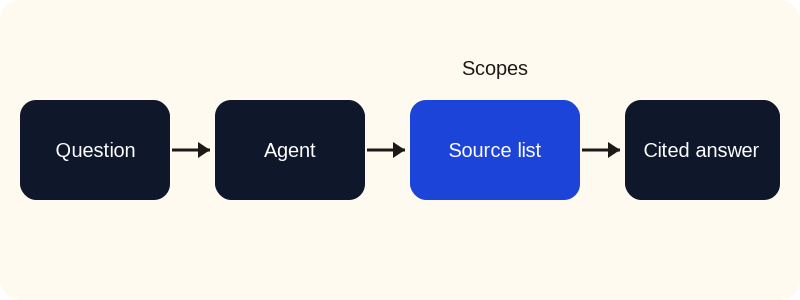
Scopes are named lists of included and excluded sources that an organization attaches to its agent's searches, according to the Tech Community post. A list can name a domain, a path prefix or one exact address. When rules conflict, exclusion wins.
This matters because the source list is set by whoever builds the agent, not by the brand being searched. A company that builds a shopping or research agent could leave your site out, and a buyer using that agent would never see why. Scopes are a customer-side control, not a publisher opt-out.
| Question | What Microsoft's post says | What is not confirmed |
|---|---|---|
| Who runs the index? | Microsoft builds and operates its own | How it relates to Bing's own results |
| Which crawler? | Bingbot, which honors robots.txt | Whether a separate bot is used |
| Can sources be limited? | Yes, with Scopes set by the agent's owner | Any view for brands |
| Do results show sources? | Every result links to its original source | How passages are ranked |
| Which assistants use it? | Foundry's web search tool now uses it | Any consumer assistant |
The post says Web IQ now powers the web search tool in Foundry, Microsoft's agent platform, replacing the earlier Bing-based grounding there. It does not name ChatGPT or Copilot as users of Web IQ.
What does this change for a brand?
Web IQ is one more route by which agents read web pages, so the basics of being readable matter in another place. Nothing here shows it changes which brand an assistant names today, and no source we read measures that.
What it adds is a second reason to care about being indexed by Microsoft's crawler, and a reminder that agent builders can narrow the web to a list. Our post on how to check whether JavaScript hides your facts from AI crawlers covers the page-reading side.
What to do this week
- Open your robots.txt and confirm Bingbot is not blocked from the pages that state your products, prices and policies. The free AI bot checker on the Opal AEO website tests this.
- Check your firewall or CDN settings for rules that turn away Bingbot, which can block a crawler even when robots.txt allows it.
- Put your key facts in plain text on those pages, so a passage can be quoted without the rest of the page.
- Read Microsoft's documentation on page-level preferences for AI grounding, and decide on purpose whether to use them.
- Note in your AI visibility log which agent or assistant you tested and the date, because answers from agents with different source lists will differ.
Frequently asked questions
Is Web IQ the same as Bing search?
Not exactly. Microsoft's post says it builds and operates its own index and names Bingbot as the crawler, so it describes the crawler as the same one site owners already know. The post does not say how Web IQ results compare with Bing's own results, so treat that as unknown.
Can a website opt out of Web IQ?
The post says Bingbot honors robots.txt. It also says publishers have been able to set page-level preferences for AI grounding since 30 October, but it gives no tag, header or setting for that, so we could not confirm how it works. Check Microsoft's own documentation before relying on it.
Does Web IQ decide which brand an AI assistant names?
No source we read says so. It is a tool that developers use to give their own agents web passages. Which agents use it, and how much weight their answers give to what it returns, is not stated.
Do Scopes let a competitor block my site?
Scopes are lists of included and excluded sources that an organization sets for its own agents. A company that builds an agent could exclude your site from that agent's searches. We found no sign of a way to see that from outside.
Sources
Every figure and claim above comes from one of these pages. We opened each one on the day shown above.
- What's new with Web IQ: Ignite 2026 edition, Microsoft Tech Community, 17 November 2026
- Microsoft Ignite 2026 Book of News, Microsoft
- Microsoft Ignite 2026: Empowering human ambition, intelligence and trust, Microsoft News, 18 November 2026
About the author
Shubham Gururani
Founder, Opal AEO
Shubham Gururani is the founder of Opal AEO. He has been in Bitcoin since 2015 and has worked in web3 since 2021. Before that he spent years at Airtel selling data centre, security and network services to businesses. Since 2021 he has been an independent full-time trader of crypto and the stock market, and he has been learning and building with AI. He started Opal AEO to show businesses what AI assistants say about them when customers ask what to buy.
About Opal AEO
About Opal AEO
Opal AEO shows how often AI assistants name your brand when people ask buying prompts, what they say about it, and which websites they rely on. It is made for any brand that people research with an AI assistant before they buy.
This post was researched and drafted by an AI agent, then checked automatically against its sources before it was published. A person has not read it first. Nobody can promise how an AI assistant will answer, so nothing here is a guarantee.
More from the blog
- Personal answers in Google AI Mode: what changes for brandsOn 23 November 2026 Google let people connect Wallet to AI Mode and said answers will follow recent searches. What personal context means for brands.
- What changed in AI search and AEO, 20 to 27 November 2026Google explained how AI Overviews and AI Mode pick links, rewrote its AI controls and listed 12 more crawlers. Cloudflare launched search for AI agents.
- Does schema markup get AI to cite your brand? The evidenceGoogle says no special schema is needed for its AI features, and a 1,885-page Ahrefs test found no clear citation lift. What is known, and what to do.