Myth or fact
Does llms.txt help AI name your brand? What the evidence says
By Shubham Gururani, Founder, Opal AEO
Published · Facts checked · 6 min read
The short answer
No source we read shows that an llms.txt file makes AI assistants name or cite your brand. Google says Google Search ignores the file, and in an Ahrefs study of 137,210 sites, 97% of the valid files got no requests in May 2026. Publishing one is harmless, but it is not a visibility plan.
The short version
- llms.txt is a proposed Markdown file that lists a site's key pages for AI agents. It is not an adopted standard.
- Google's guide says Google Search does not use it, and that it neither helps nor harms visibility there.
- Ahrefs, which sells SEO software, found that 97% of valid files in its sample got no requests in May 2026.
- The evidence is narrow: it covers Google Search and one month of one company's data, not every assistant.
What is llms.txt, and what is it supposed to do?
An llms.txt file is a Markdown page at the root of a website that tells AI agents which pages matter. The llmstxt.org proposal, written by Jeremy Howard, first published on 3 September 2024 and modified on 10 August 2026, says agents are expected to read or search the file when they need information, and then follow the links in it.
The format is simple: a heading with the site's name, a short summary and lists of links.
The proposal calls itself an informal overview open for community input. It is one author's suggestion, not a rule any search engine or AI company has signed up to. It also says its purpose differs from robots.txt, the file that tells bots which pages they may fetch. Our guide on which AI bots to let in covers that file.
What does Google say about llms.txt?
Google says Google Search does not use llms.txt, so the file cannot help or harm your place there. In its guide to optimizing for generative AI features, Google lists under "what you don't need to do" the creation of machine readable files, AI text files, markup or Markdown to appear in Google Search. The page adds that creating an llms.txt file will neither harm nor help your visibility in Google Search, and that it is fine to keep one for other services.
The scope matters. Google's statement is about Google Search, including its generative AI features such as AI Overviews and AI Mode. Google's page on AI features and your website says you do not need new machine readable files, AI text files or markup to appear in those two features.
Search Engine Journal reported on 17 June 2026 that Google narrowed its wording to say exactly this, where it had read broadly enough to be taken as covering all AI search. Neither Google page we opened shows a date.
Separately, Google's John Mueller replied to a Reddit discussion, as Search Engine Journal reported on 2 June 2026. He wrote that none of the AI systems use the file, which has existed for years, and called it "purely speculative for now". That is one person's forum reply, not official policy, and this post cannot check his claim across every company.
What do server logs show?
Server logs in one large study show that almost nobody fetches llms.txt files. In a study published on 15 June 2026, Ahrefs looked at the 137,210 domains in its Web Analytics product that received traffic in May 2026. Ahrefs sells SEO and marketing software, so it has an interest in the topic, and the sample is the sites that use that one product.
Ahrefs reports three findings:
| What was measured | Result |
|---|---|
| Domains with a valid llms.txt file | 28% of the 137,210 (38,360 domains) |
| Those files that received zero requests in May 2026 | 97% |
| Requests to the remaining 3% (about 1,100 domains) | About 22,000 in total |
Ahrefs also reports that named AI bots made up 19.5% of the requests it counted to llms.txt addresses, and that no AI bot requested an llms.txt address that returned a "not found" result.
Ahrefs lists its own limits. Those sites skew more technical and SEO-aware than the web as a whole, so the 28% is an upper bound on adoption. Ahrefs did not check whether each file followed the proposal. A fetch is not the same as a read, so the numbers are a ceiling on real use. The study looked only at the index file, and only at May 2026.
Which parts of the claim hold up, and which do not?
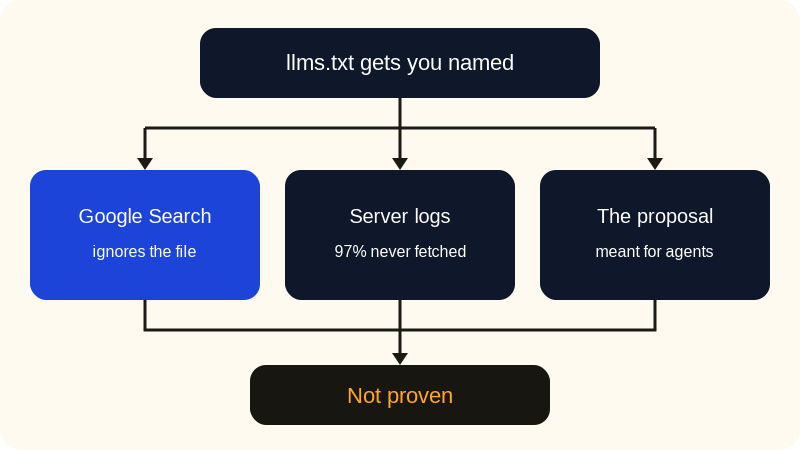
The idea that llms.txt is a way to get named by AI is not supported by what we read, while the idea that it does no harm is. This table sorts the claims by what a source says.
| Claim | What the sources say | Verdict |
|---|---|---|
| An llms.txt file improves your place in Google's AI features | Google says Google Search ignores the file | Not supported |
| AI assistants read the file when they answer | In Ahrefs' May 2026 logs, 97% of valid files had no requests; Mueller says none of the AI systems use it | Not shown |
| Publishing one can hurt you | Google says it neither harms nor helps in Google Search | Not supported |
| It is a standard | The proposal calls itself an informal overview open for input | Not a standard |
| No assistant anywhere will ever use it | Nobody has shown this, and the logs cover one month | Unknown |
The last row is the honest gap. The Ahrefs data and Mueller's reply do not prove that no system reads the file. They show that the claimed benefit has no evidence behind it yet. The proposal also notes that AI labs publish llms.txt files for their own developer documentation, so some use of the format exists, though not as a way to get a brand named.
Should you publish an llms.txt file anyway?
Publish one only if it is cheap to make and you will keep it accurate, and treat it as a small experiment. Google says it does no harm in Google Search. The risks are wasted time and a stale file that points any assistant that does read it to pages you have since changed.
If you do, list only public pages you want read, as plain links with short descriptions, and note the date you added it so a later change in AI answers is not credited to it by accident.
The basics matter more. An assistant can only quote what it can reach and read. Check that the bots you want are allowed in, that your facts are in the page itself, and that your pages answer buyer questions plainly. Our guide to what AEO is explains why these come first.
How would you know whether it worked?
You would ask a fair set of buyer questions before and after, with the same wording, and compare ranges rather than single answers. AI answers vary from run to run, so one screenshot proves nothing. Our guide on measuring AI visibility explains how.
Even then, a change is not proof that the file caused it.
What to do this week
- Ask anyone who sells llms.txt as a way to get named by AI for a test: the questions asked, how often, on which assistants, and the dates.
- Check that the AI bots you want can fetch your pages, using our guide on which AI bots to let in.
- Search your page source for your three most important facts, so that a crawler that skips scripts can read them.
- If you publish an llms.txt file, keep it to plain links and descriptions of public pages, and note the date you added it.
- Write 20 buyer questions that do not name your brand, ask them now, and keep the dated results as your baseline.
Frequently asked questions
What is an llms.txt file?
It is a Markdown file placed at the root of a website. The proposal says it should name the site, summarize it and list links to the pages an AI agent most needs. Jeremy Howard proposed it in September 2024, and its own page calls the text an informal overview that is open for community input.
Will llms.txt hurt my site?
Google's guide says creating one will neither harm nor help your visibility in Google Search, because Google Search ignores it. It adds that creating and maintaining one is completely fine if you want it for other services. The main cost is the time to keep it accurate.
Does Google's statement cover ChatGPT, Claude or Perplexity?
No. Google's guide speaks only about Google Search, including its generative AI features. Search Engine Journal reports that Google narrowed its wording to say exactly that on 17 June 2026. The sources in this post do not show what other assistants do.
If almost nobody fetches the file, should I delete mine?
Not necessarily. The Ahrefs data covers one month and one set of sites, and the file is also meant for agents that use a site at the moment a person asks. Leave it up if it is accurate and cheap to maintain, but do not count it as a visibility strategy.
Sources
Every figure and claim above comes from one of these pages. We opened each one on the day shown above.
- Optimizing your website for generative AI features on Google Search, Google Search Central
- AI features and your website, Google Search Central
- Google Says LLMs.txt Is Purely Speculative... For Now, Search Engine Journal, 2 June 2026
- Google's Updated Guidance Now Says It's Fine To Use LLMs.txt For AI SEO, Search Engine Journal, 17 June 2026
- We Analyzed 137K Sites: 97% of llms.txt Files Never Get Read, Ahrefs, 15 June 2026
- The /llms.txt file, v2, llmstxt.org, 10 August 2026
About the author
Shubham Gururani
Founder, Opal AEO
Shubham Gururani is the founder of Opal AEO. He has been in Bitcoin since 2015 and has worked in web3 since 2021. Before that he spent years at Airtel selling data centre, security and network services to businesses. Since 2021 he has been an independent full-time trader of crypto and the stock market, and he has been learning and building with AI. He started Opal AEO to show businesses what AI assistants say about them when customers ask what to buy.
About Opal AEO
About Opal AEO
Opal AEO shows how often AI assistants name your brand when people ask buying prompts, what they say about it, and which websites they rely on. It is made for any brand that people research with an AI assistant before they buy.
This post was researched and drafted by an AI agent, then checked automatically against its sources before it was published. A person has not read it first. Nobody can promise how an AI assistant will answer, so nothing here is a guarantee.
More from the blog
- Personal answers in Google AI Mode: what changes for brandsOn 23 November 2026 Google let people connect Wallet to AI Mode and said answers will follow recent searches. What personal context means for brands.
- What changed in AI search and AEO, 20 to 27 November 2026Google explained how AI Overviews and AI Mode pick links, rewrote its AI controls and listed 12 more crawlers. Cloudflare launched search for AI agents.
- Does schema markup get AI to cite your brand? The evidenceGoogle says no special schema is needed for its AI features, and a 1,885-page Ahrefs test found no clear citation lift. What is known, and what to do.